SEO vs GEO: Differences, Examples & Why it Matters in 2026
.png)
- SEO & GEO now runs search. SEO wins rankings and clicks in Google. GEO wins mentions and citations in AI answers (ChatGPT, Gemini, Perplexity).
- They reward different signals. SEO: keywords, site health, links, authority. GEO: clear structure, specificity, proof, freshness, entity consistency.
- GEO builds on a strong SEO foundation. Baseline current GEO visibility, show up where large language models (LLMs) pull from, focus on YouTube, Reddit, review sites, and listicles to get an extra search engine result page (SERP) slot.
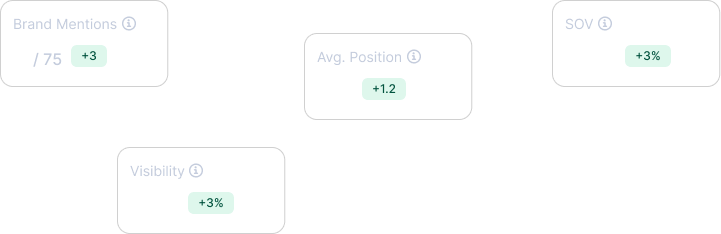
- Track GEO: Measure mentions, share of voice, citations, sentiment, and position regularly.
SEO vs GEO is now behind every serious search strategy. For years, “doing search” meant SEO: fight for keywords, links, and snippets to win a click from a classic results page.
In 2026, that’s only half the story. Buyers still use traditional search, but they also turn to AI answer engines like ChatGPT to ask questions, summarize, compare, and recommend.
And AI-assisted search: Google’s AI Overviews/AI Mode gives users instant answers and reduces clicks. Around 58.5% of Google searches in the US and 59.7% in the EU ended with no click.
In this article, we’ll define SEO and GEO, explore the differences, and show how to optimize and measure each. We’ll also cover 2026 trends, whether GEO is replacing SEO, how they work together, and how to track AI search visibility with an AI visibility tool.
What is SEO (Search Engine Optimization)?
SEO is the process of improving your website so it ranks higher in traditional search engines like Google. It helps crawlers understand, trust, and recommend your pages for specific queries through relevance, strong keywords, good site health, and authority signals.
How does it work?
Search engines crawl your pages, index what they understand, then rank results based on relevance and quality. Rankings are influenced by on-page content, technical factors (speed, mobile, internal links), and authority signals like backlinks and brand trust.
What is GEO (Generative Engine Optimization)?
GEO (Generative Engine Optimization) is the process of optimizing content so AI answer engines (ChatGPT, Perplexity, Gemini, etc.) include, quote, or cite your brand in generated responses. Instead of ranking for clicks, you optimize to be selected for answers.
How does it work?
LLMs often reformulate a user’s question to better align with the user's intent. They then pull context from multiple sources (often what already shows up in the SERP). A summarization model compiles and rewrites that information into a single response, sometimes with citations.
SEO vs GEO: The Core Differences
Here are the key differences between SEO and GEO.
How to Optimize for SEO vs GEO
SEO and GEO aren’t competing playbooks; they stack, and here’s how you can optimize for both.
SEO Foundations You Still Need
If you want SEO and GEO to work, you still need a solid Google base first:
- On-page basics: Strong titles/H1s, clear intent, and tight internal anchors to key pages.
- Crawlable, indexable site: Key pages accessible, fast, no accidental blocks, clean internal linking.
- Build the pages Google (and buyers) expect: Product, use case, industry/role, comparison, help/FAQ.
- Map a Google-focused content strategy: Start with your category and your “money” topics, and prioritize bottom-of-funnel (BoFu) and middle-of-funnel (MoFu) terms tied to revenue.
- Add schema: Use product, FAQ, review, and breadcrumb markup for clearer context.
- Authority signals: Earn a few relevant editorial links and mentions to lift page-1 odds (which also increases AI pickup).
GEO optimization steps (what to do)
1. Set Your Baseline GEO Visibility
Before you “optimize,” measure where you show up today.
- Build a small prompt set (20–50) across Google AI Overviews, ChatGPT, Perplexity, etc.
- Start with your highest-value queries (brand, product/features, core use cases, comparisons), then run a sample and record what the AI returns.
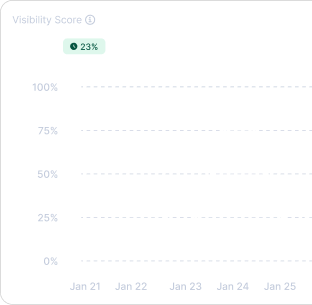
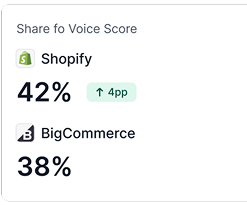
Instead of spending hours manually tracking this, automate it with an AI visibility tool like WorkDuo to compare your brand’s mention rate versus competitors for each query and roll it up into a clear visibility score.
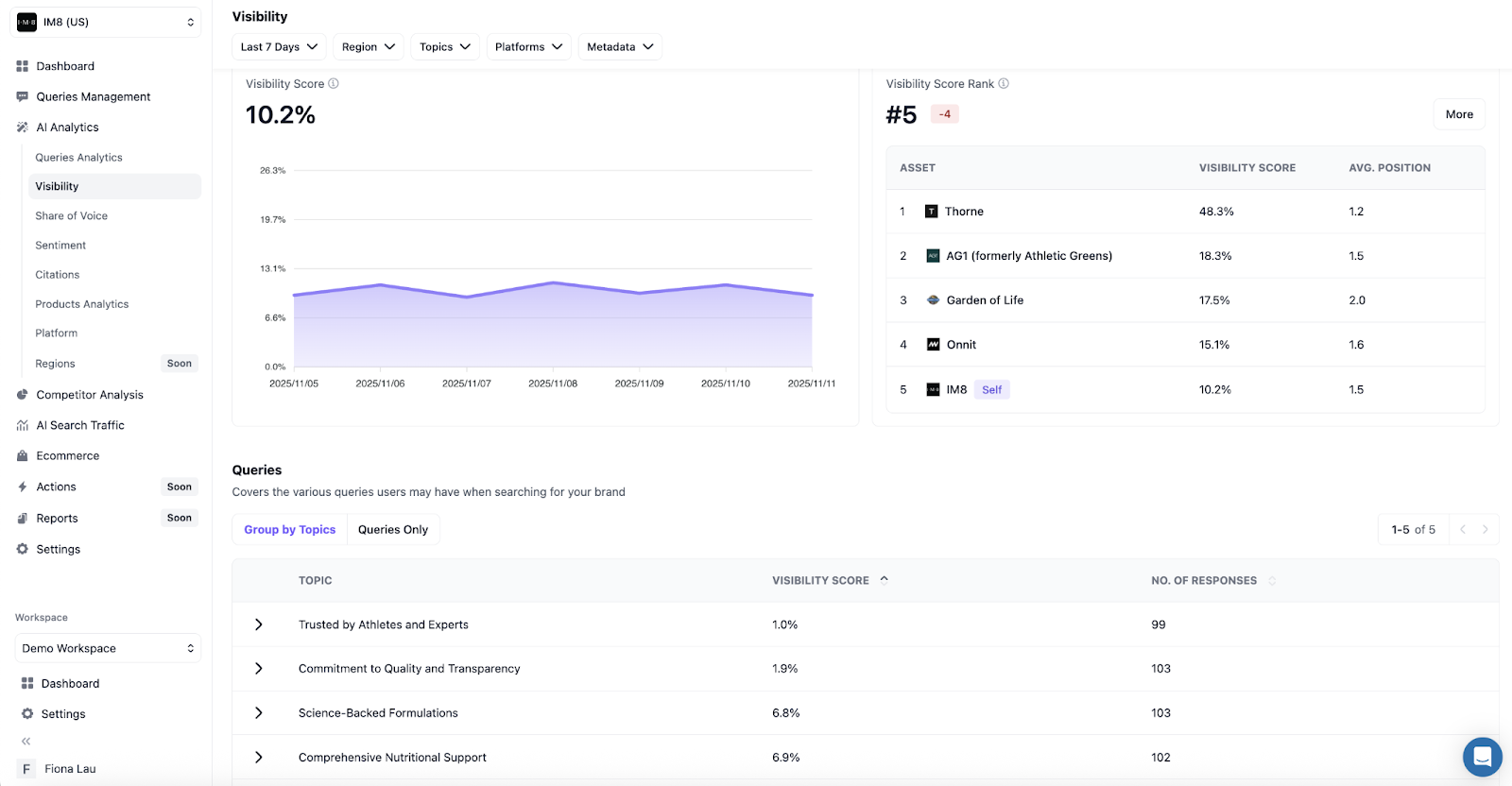
For each prompt, you can note:
- Do you appear?
- How are you described?
- Which competitors appear?
- Which domains are cited/summarized?
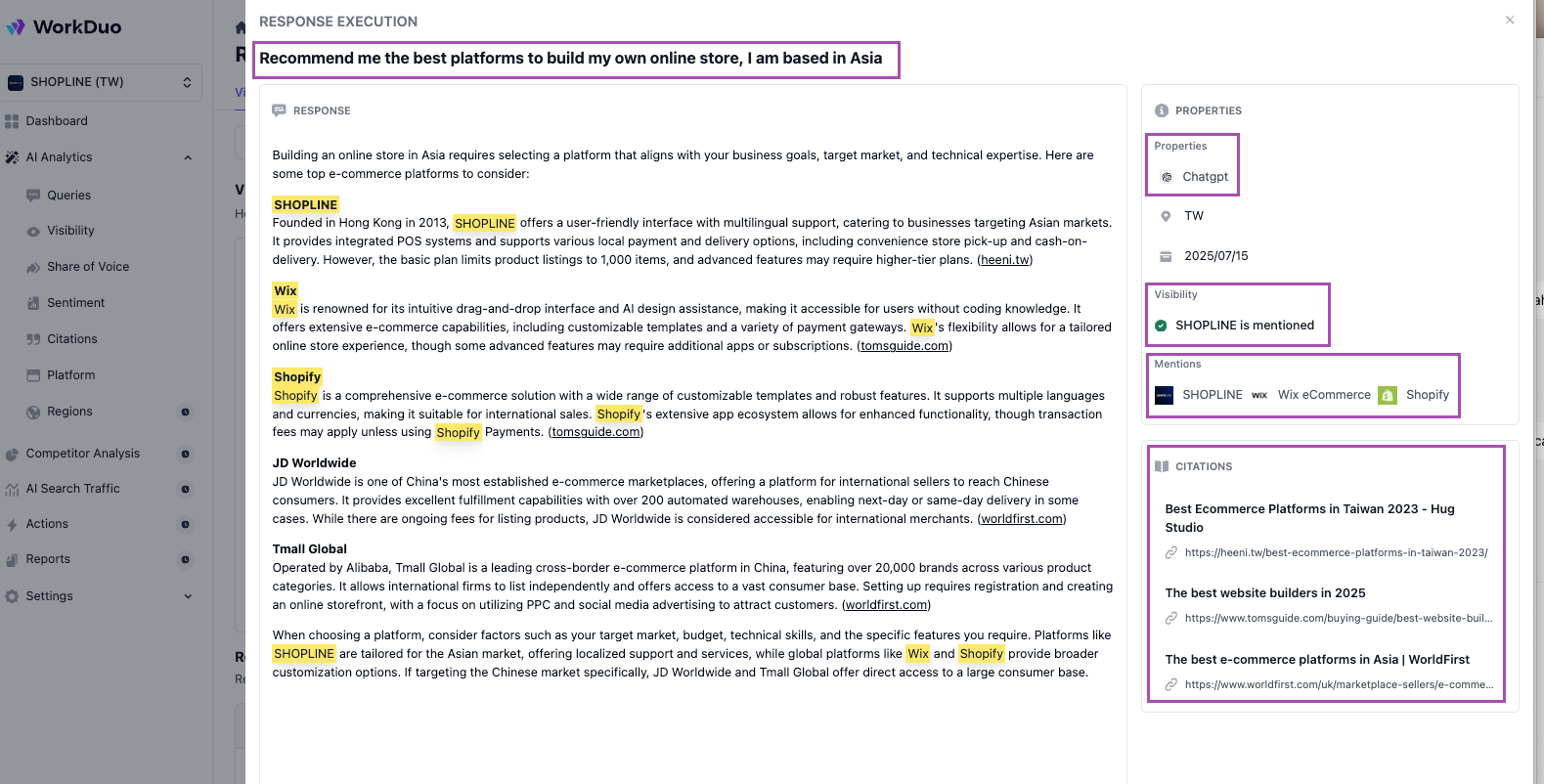
2. Start With Your Best Users, Then Turn Their Keywords Into a Prompt Bank
Don’t start with “every keyword.” Start with the segment that moves revenue.
- Identify high-lifetime-value (LTV) and low-churn (or highest-retention) user segments.
- Map their jobs-to-be-done, pain points, and “why they chose you.”
- Convert that into keywords, then into a prompt bank, e.g.:
- Product prompts: “best [category] software for…”
- Industry/role prompts: “best [category] for finance teams/agencies / IT.
- Implementation prompts: “how to implement/migrate/integrate…”
3. Be Present Where LLMs Actually Pull Answers From
LLMs don’t rely on one site. They pull and synthesize from many places. Run your priority prompts and study the answer inputs.
- What domains are clearly cited or heavily reflected?
- What formats dominate
- Long-form guides AND comparison pages,
- “best tools” listicles,
- Reddit threads,
- YouTube transcripts
- Review sites (G2/Capterra-style)
- Help centers/FAQs
- Wikipedia/entity pages
Group the sources by type and intent to spot patterns. This “source map” shows where you actually need coverage for each prompt, so you’re not guessing.
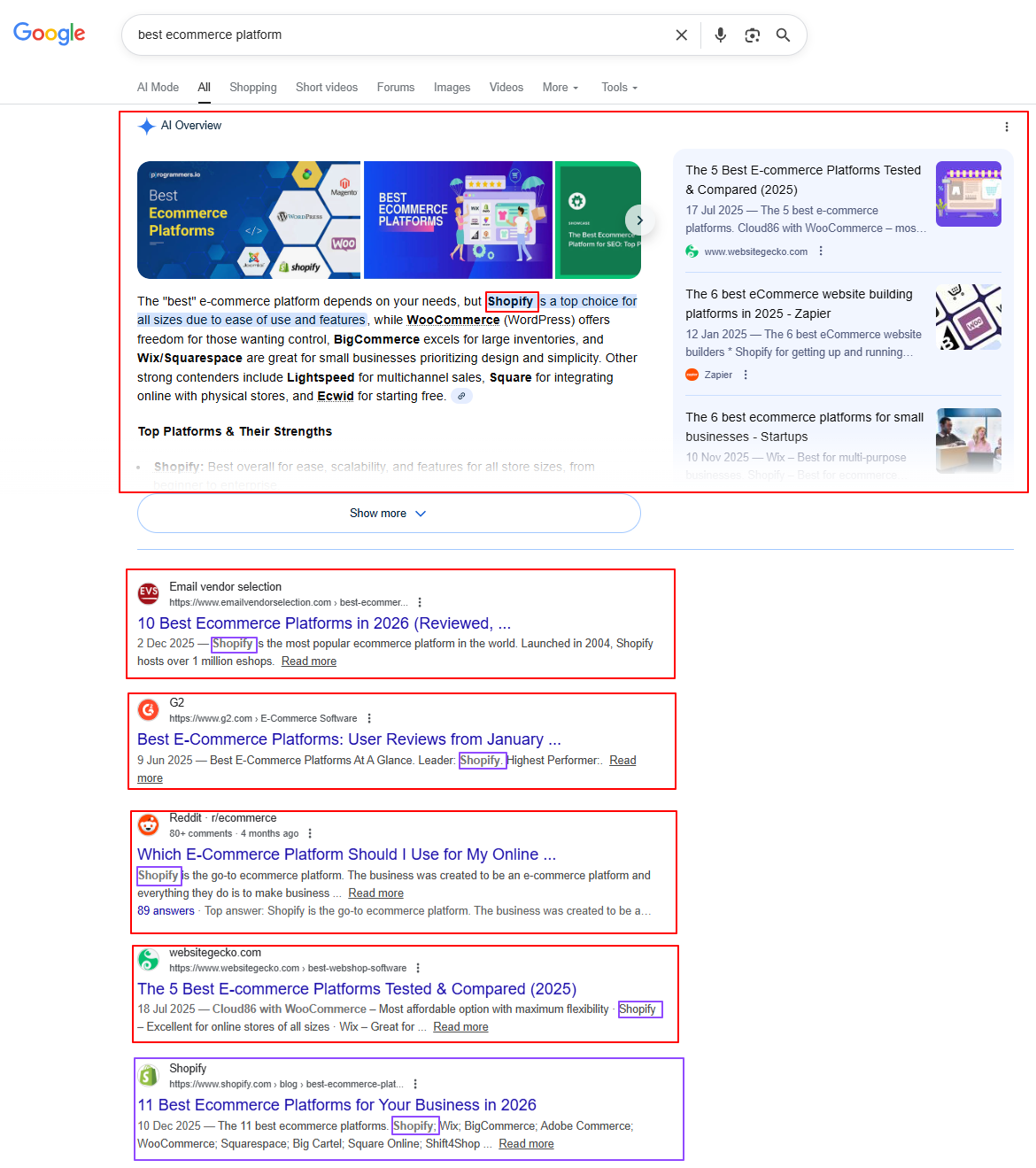
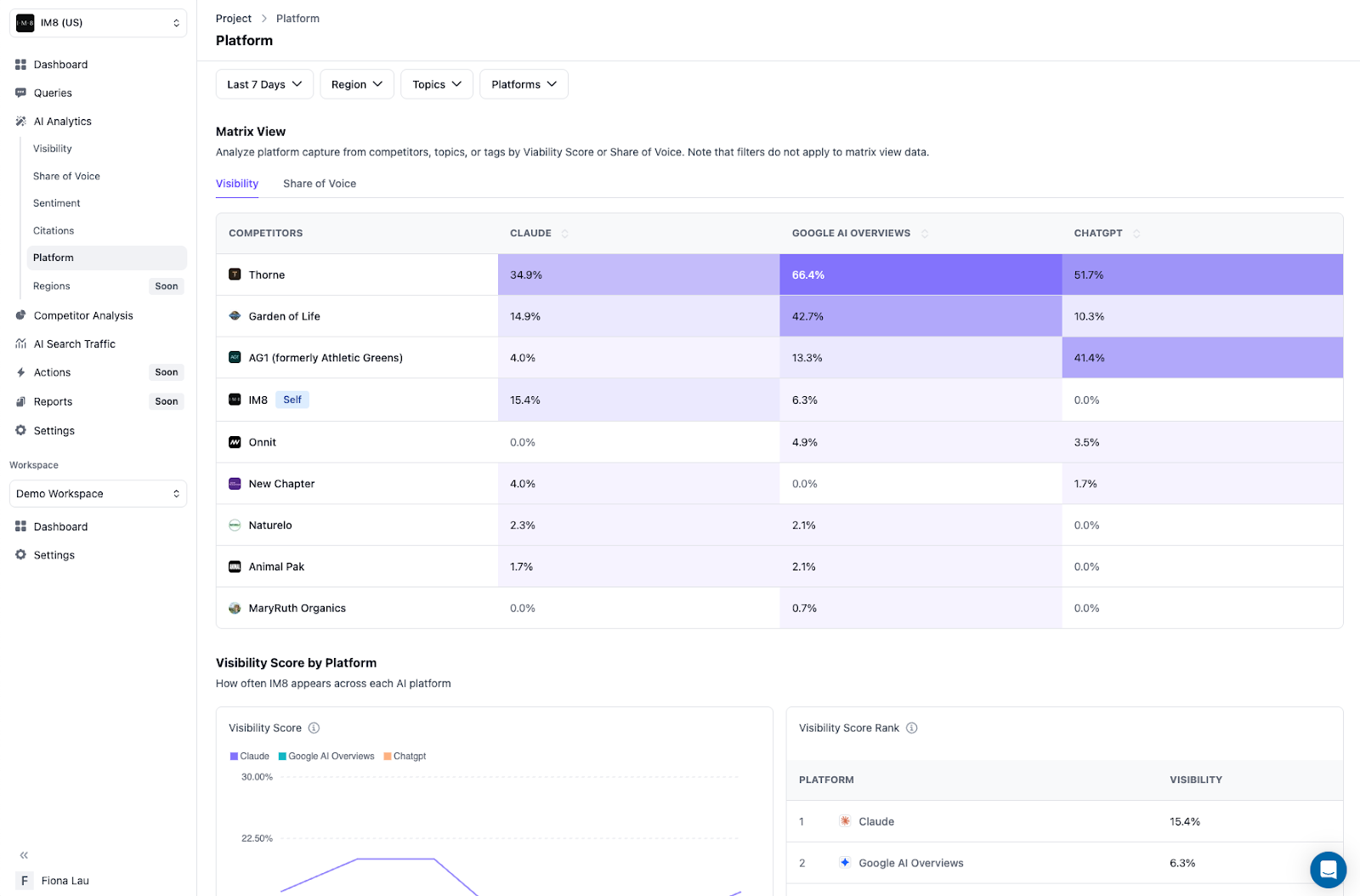
A good example is “Shopify,” which surfaces in multiple SERP features for “best ecommerce platform.”
4. Prioritize Revenue-Moving Prompts, Then Decide the Fastest Asset to Ship
Work through this funnel:
- Identify “money prompts” (high-intent queries like “best [category] tools”, “[Brand] vs [Competitor]”, “[Brand] review”, or “[tool] for [use case]”)
- Check which sources dominate today, choose the fastest asset (Reddit thread, YouTube video, etc.) to influence them, then ship what the model is already rewarding.
5. Build LLM-Friendly Pages on Your Site
When you create or improve a page, apply these GEO best practices that make your content easy to surface in AI-generated responses.
6. Win the Listicle
LLMs often rely on page-1 listicles to infer the “consensus” set of recommended tools.
To get included:
- Target BoFu keywords where listicles dominate
- Run outreach to secure placements,
- Track your inclusion over time
7. Use YouTube as an Extra SERP Slot and a GEO Amplifier
Pick high-intent topics (comparisons, implementations, “how-to”), publish consistently, and ensure transcripts match your key messaging.
8. Seed Long-Tail Details in Community Threads Like Reddit
Contribute authentic, helpful comments that add real detail (use cases, constraints, “we tried X, here’s what happened”).
Pro tip: Add multiple perspectives across threads over time (not spam, not repetitive).
9. Track GEO Like a Real Channel
Measure GEO weekly and iterate. Track visibility rate, mentions, citations, and how often you’re recommended for priority prompts. Don’t “set and forget.”
Measuring Metrics: SEO vs GEO
Use this table to compare the metrics that matter for SEO (search performance) versus GEO (AI answer visibility).
If you want to track GEO properly, you need a tool that reflects what users actually see, not just API outputs.
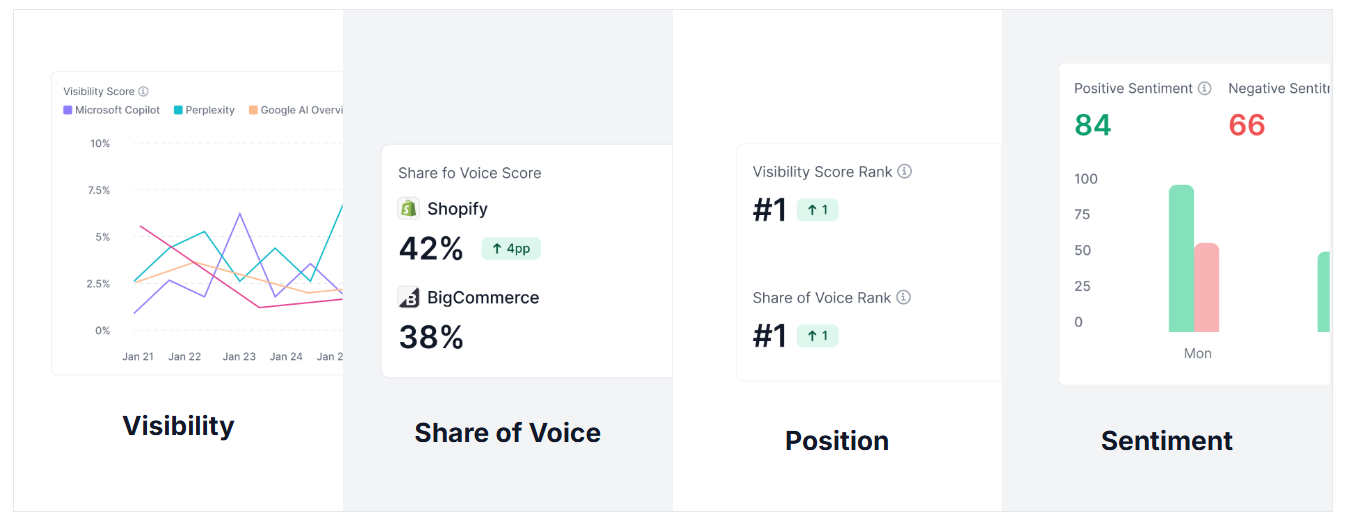
WorkDuo acts as an AI visibility command center, using front-end scraping (real-time browsing) to capture mentions, citations, and brand framing across ChatGPT, Gemini, and more.
GEO and SEO trends in 2026
These are the biggest shifts to watch in SEO and GEO in 2026.
1. Google And AI Answers Will Stay As Core Discovery Channels
In 2026, discovery will still start with Google or an AI answer engine. Buyers will move between both to explore options, validate claims, summarize information, and compare suppliers, Staying ahead of these shifting AI search trends ensures your brand remains visible as user behavior evolves from clicks to conversations.so sales conversations start with higher-intent, better-informed prospects.
2. YouTube Becomes A Serious Search Investment
YouTube will shift from “optional” to a core search channel as video captures more Google SERP space and is surfaced inside AI-generated answers, especially for comparisons, complex products, and “how does this work” queries.
3. More Brands Will Build Wikipedia Pages
More brands will build (and maintain) a Wikipedia presence to strengthen AI credibility and knowledge graph signals. Because Wikipedia is treated as a trusted reference, brands without coverage risk being excluded from AI answers.
4. Reddit Will Remain Influential in Search
Reddit will stay highly relevant for both traditional and AI search. Its high-volume, experience-driven discussions keep ranking on Google and often shape what AI engines summarize, cite, or recommend.
5. GEO Tools Gain Market Share
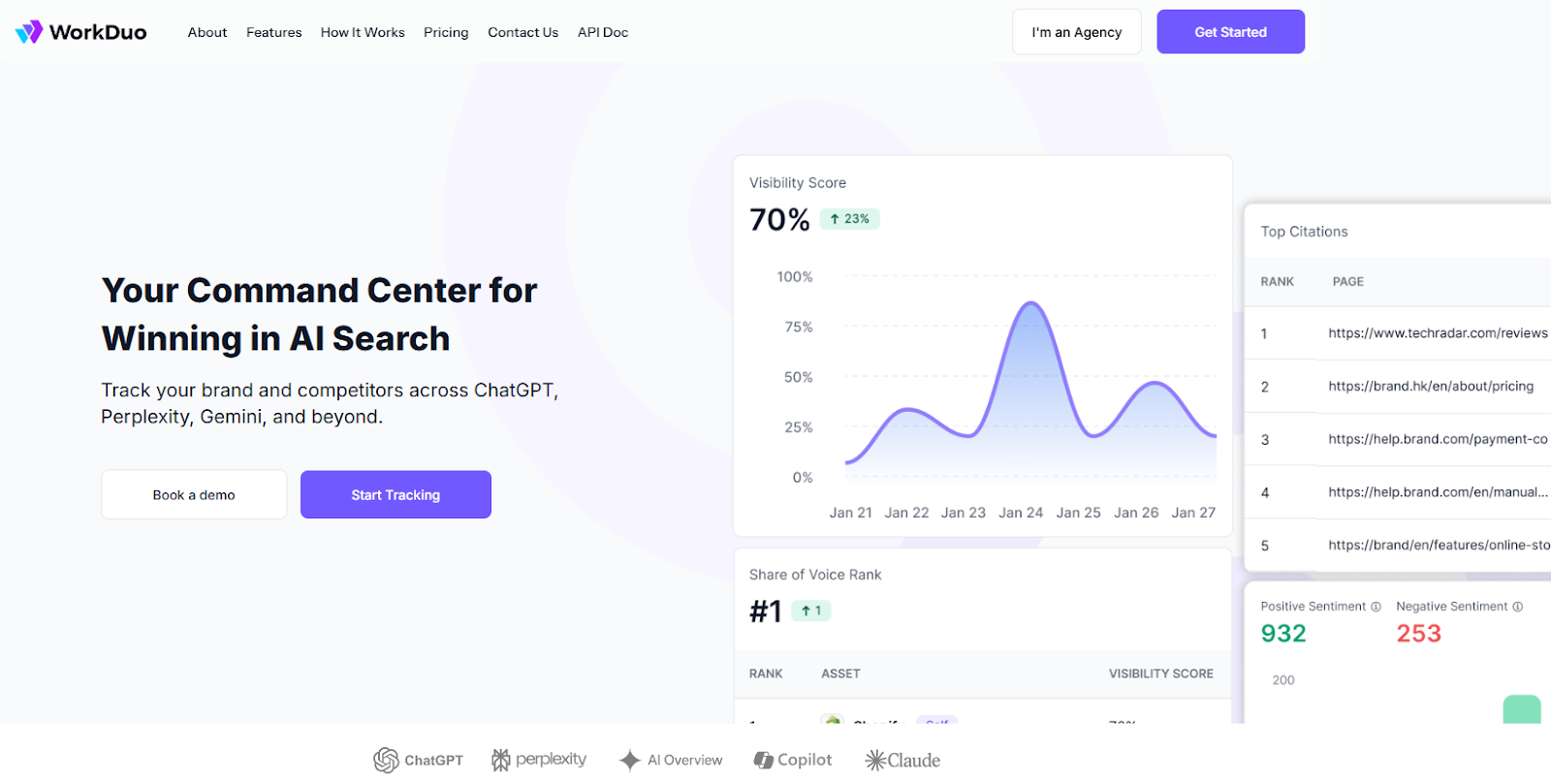
As AI answers replace some clicks, visibility in answers becomes a KPI. This is driving the adoption of GEO/AEO software like WorkDuo to track mentions, citations, etc.
Is GEO Replacing SEO?
No. Google still drives most search demand, with about 90% of the global search engine market share.
AI Overviews may answer more queries in the SERP, but they still pull from authoritative pages. SEO is still how you earn eligibility, rankings, and traffic.
GEO builds on SEO. People might discover you in an AI answer, then later Google you, check reviews, watch a video, and finally convert.
Can GEO and SEO work together?
Yes. GEO and SEO still work together. SEO gets your pages indexed, ranking, and earning trust signals; that same visibility feeds AI features that synthesize from multiple sources.
Then GEO builds on that by widening your footprint across other sources AI pulls from (YouTube, Reddit, review sites, listicles), with a clear structure, but it doesn’t replace the Google SEO engine.
See How Your Brand Shows Up Across AI Search with WorkDuo
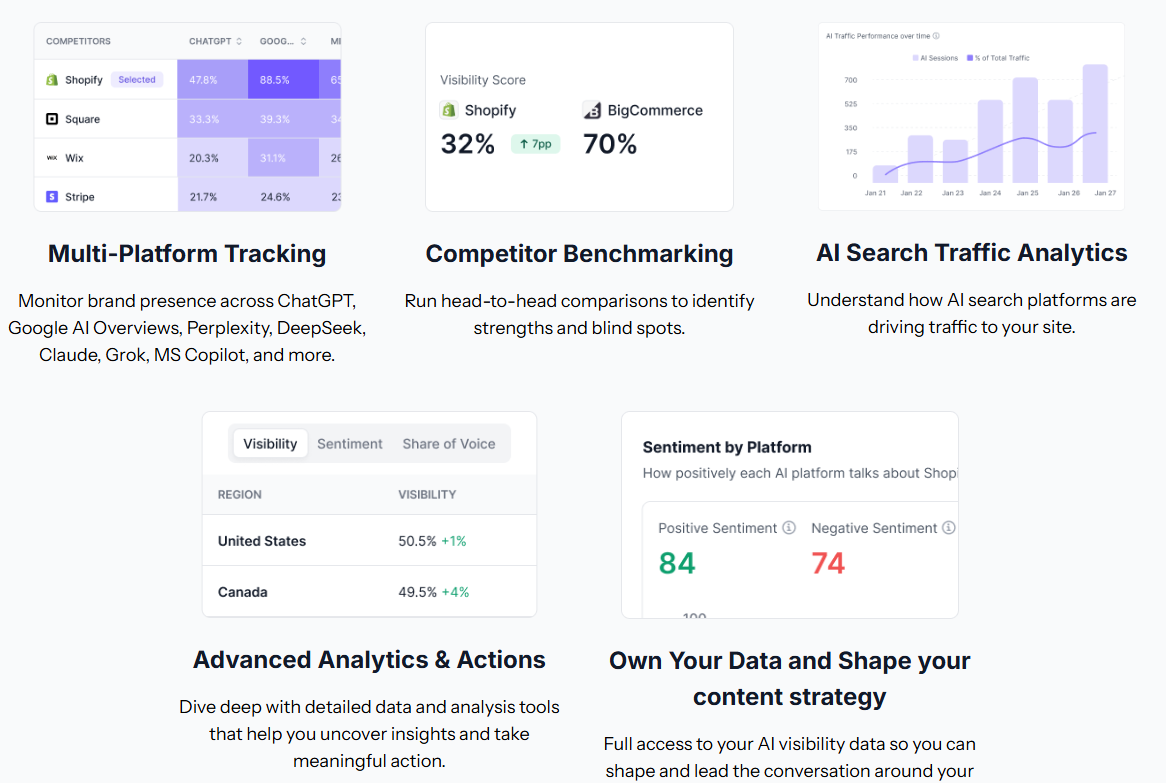
AI answers are becoming the first impression of your brand, often before anyone ever visits your site.
WorkDuo lets you see that impression without guesswork, spot gaps, and catch misquotes early before they cost you.
Track how you’re framed, where competitors outrank you in answers, and what to publish next to win the shortlist.
Fiona is the Co‑Founder of WorkDuo AI, where she helps brands optimize their AI search visibility. Previously, she co‑founded SHOPLINE, a smart commerce platform in Asia, and led its successful exit to a NASDAQ‑listed company in 2022. With deep expertise in scaling tech businesses and working with global investors, Fiona now advises startups on growth and data-driven decision-making, while leading WorkDuo’s mission to improve how brands are represented in AI-driven search.

Ready to try our product?
Sign up for a free consultation with our experts.


Follow Us on Social Media
Follow our profiles for daily updates, behind-the-scenes content, and more.




More articles