Writesonic vs Otterly AI: A Detailed Comparison [2026]
.png)
- Writesonic: Best for teams that want GEO, SEO, and AI content creation in one platform. It suits content-heavy marketing teams that want to track AI visibility while also creating and optimizing content.
- Otterly AI: Best for in-house SEO teams and agencies that want focused AI visibility tracking without paying for a broader content suite. It works well for citation tracking, competitor monitoring, and simpler GEO workflows.
- WorkDuo: Best for agencies, e-commerce brands, and multi-brand teams that need real-time tracking, product-level visibility, unlimited seats, and flexible pricing. It is a strong fit for teams that want deeper insight without enterprise-level costs.
- Choose Writesonic if: you want content creation and AI visibility tracking in one workflow. It makes the most sense for teams that value breadth over a GEO-only setup.
- Choose Otterly AI or WorkDuo if: your priority is AI visibility monitoring, not content generation. Pick Otterly AI for lighter tracking and simpler reporting. Pick WorkDuo for broader coverage, better scalability, and more actionable visibility data.
A lot of teams buy the wrong AI tool because they start with the wrong question. They ask “Which one has more features?” instead of “What do we need to do weekly: create, monitor, or both?”
With about 80% of search users relying on AI summaries for at least 40% of their searches, tools that help you operationalize AI visibility have to fit your cadence, not just your budget. Writesonic and Otterly AI can both play a role, but they solve different parts of the problem.
Writesonic vs Otterly AI vs WorkDuo: At a Glance
Who Is Writesonic Best For?
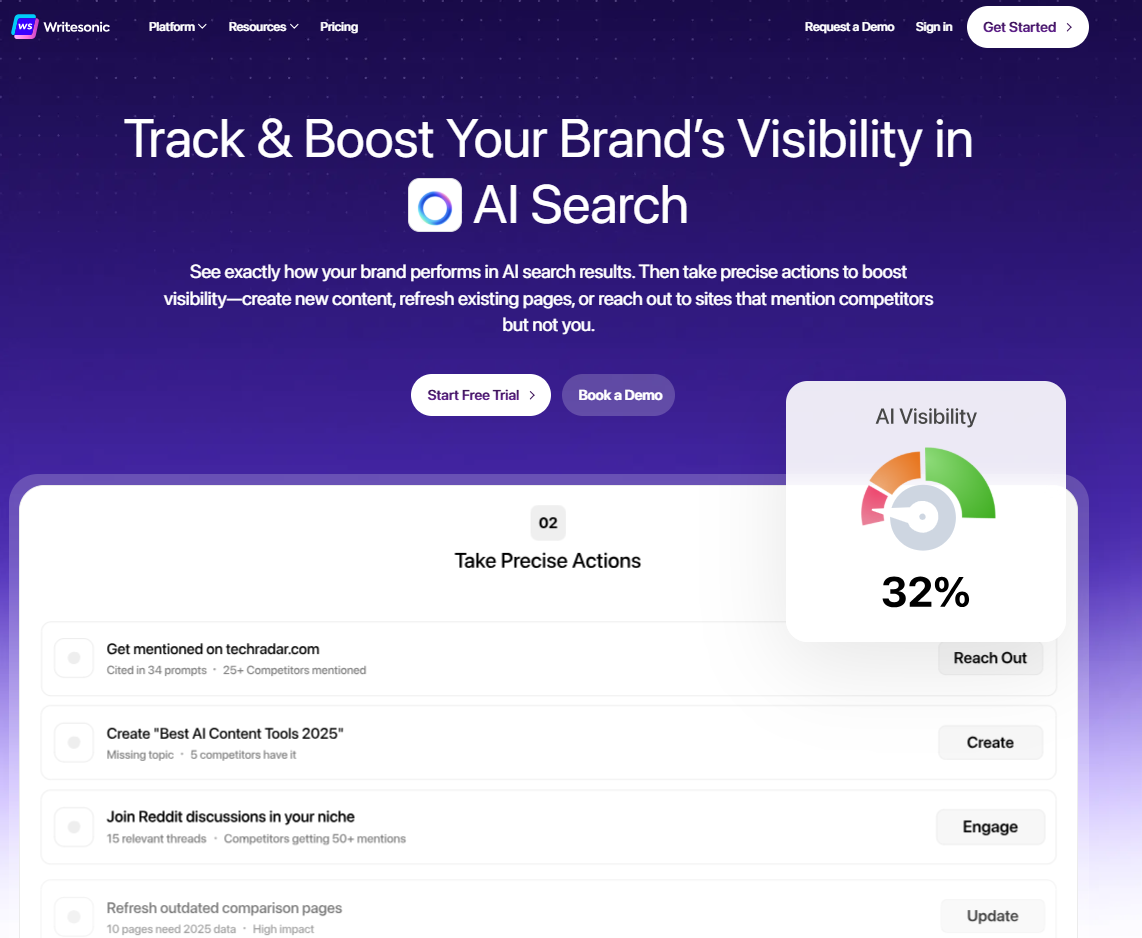
Writesonic is ideal for:
- Head of SEO / organic lead: Tracks AI visibility, share of voice, and citations across ChatGPT and AI Overviews to prove GEO impact beyond rankings.
- Content lead focused on citations: Identifies citation gaps and updates pages so they get referenced in AI answers, not just ranked on Google.
- Growth / demand gen manager: Finds prompts where competitors show up but you don’t, then prioritizes GEO actions that directly impact the pipeline.
- Agency offering GEO services: Tracks AI visibility across clients, benchmarks competitors, and turns insights into content and optimization workflows at scale.
Who Is Otterly AI Best For?
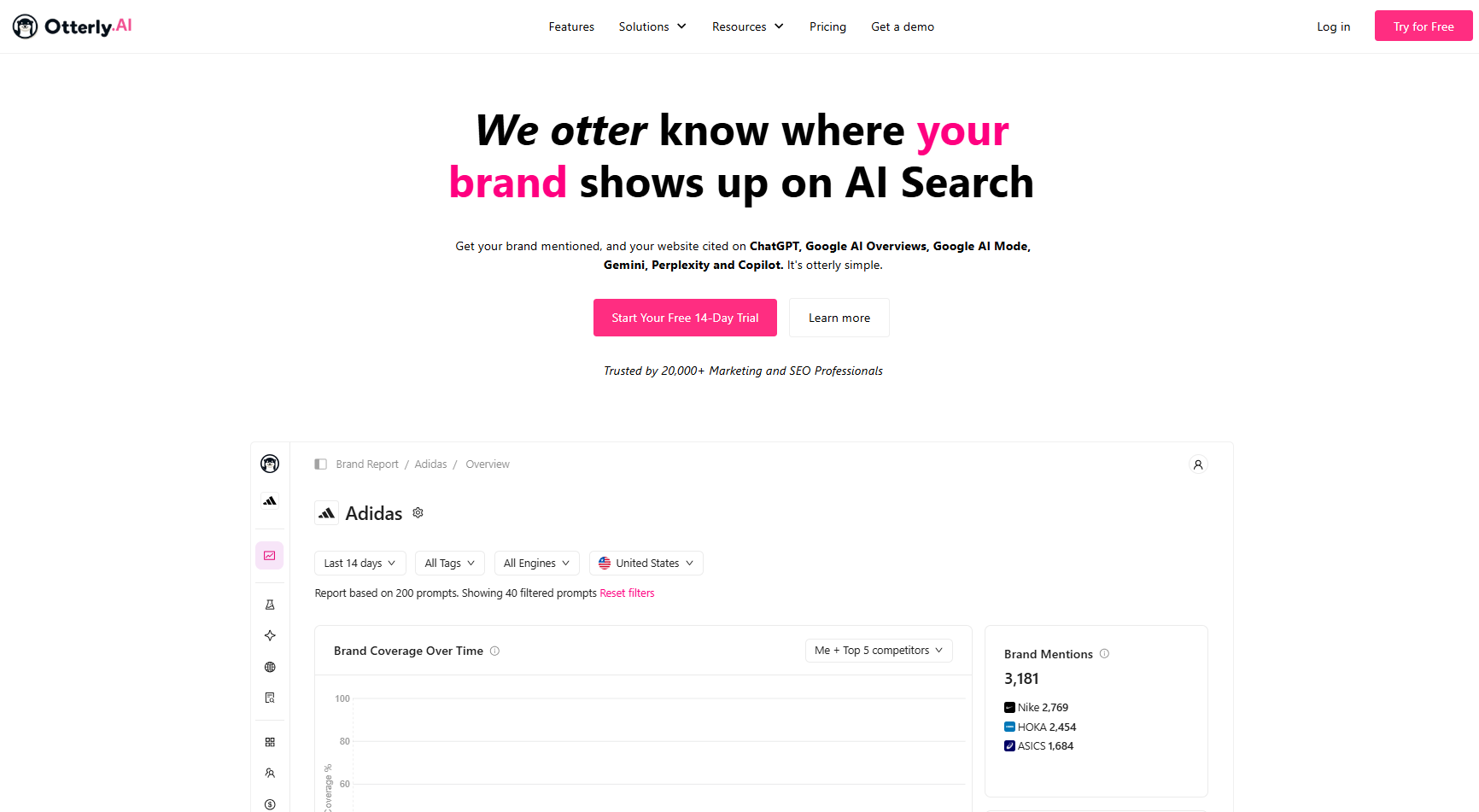
Otterly AI is usually a best fit for:
- In-house SEO and content teams: Best for teams that need to track brand visibility, citations, and share of voice across AI search platforms, then turn those insights into concrete GEO actions.
- Agencies managing GEO for multiple clients: A strong fit for agencies that want one platform to benchmark brands against competitors, spot visibility gaps, and scale optimization work across client accounts more efficiently.
- Teams running competitor-led GEO audits: Useful for marketers who want prompt-level visibility data, citation tracking, and competitor comparisons to see where rivals are being surfaced and where their own brand is missing.
- Brands that want GEO execution, not just monitoring: Best for companies that do not just want dashboards, but also want recommendations to fix citation gaps, improve content, and increase their chances of being referenced in AI answers.
WorkDuo: A More Cost-Effective, & Smarter Alternative to Writesonic and Otterly AI
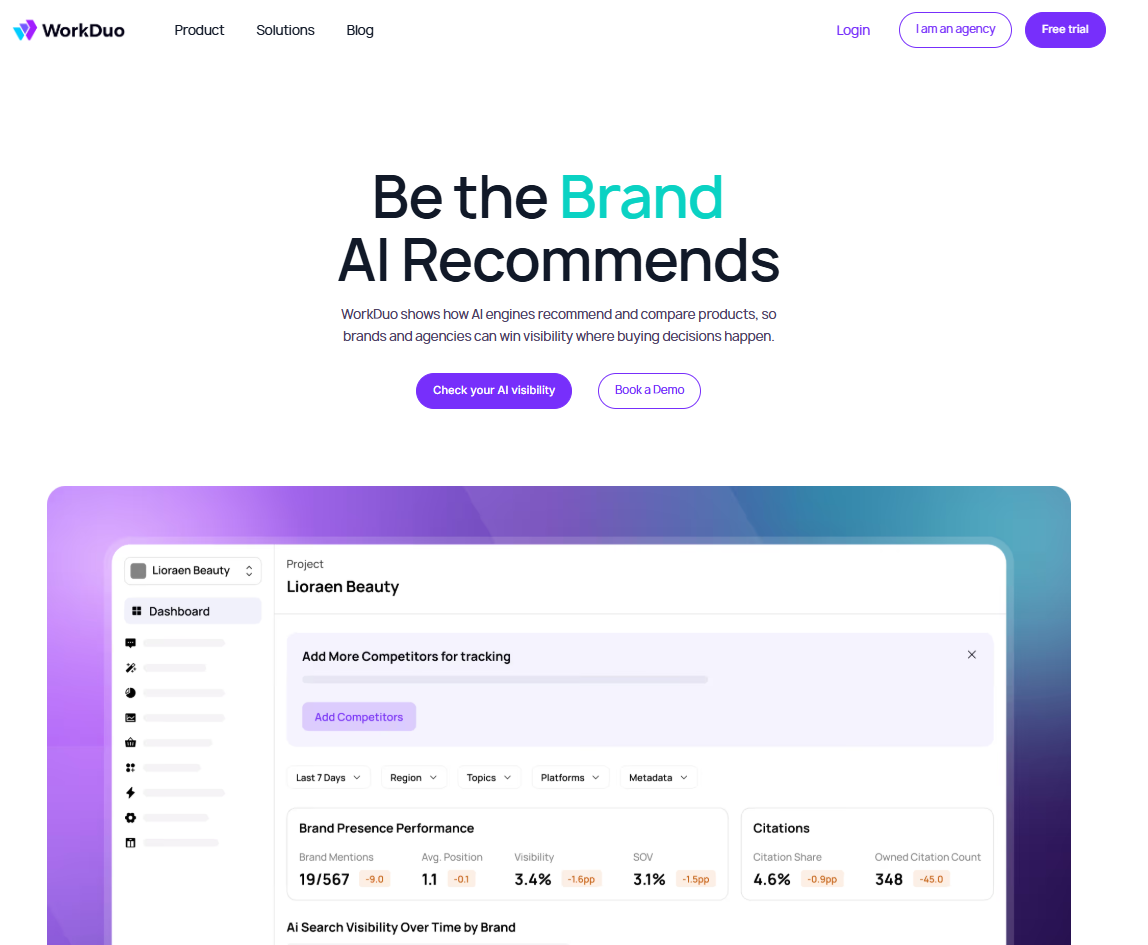
WorkDuo is designed for agencies and commerce brands needing real‑time AI search visibility and product‑level insights.
Why WorkDuo Stands Out as an Alternative
1. Real‑Time Accuracy
WorkDuo’s real‑time browser tracking replicates the exact experience end‑users see in AI interfaces. By contrast, Otterly AI uses data aggregation technology that may not reflect current answers, especially when LLM responses vary by session.
2. Deeper Insights Beyond Mentions
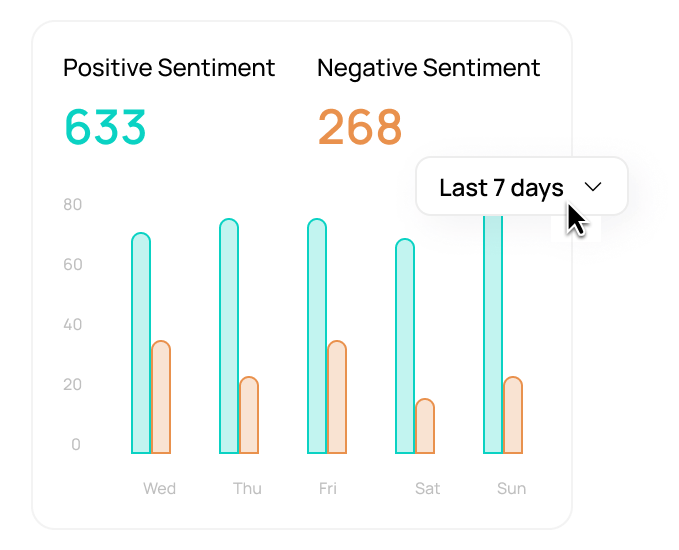
WorkDuo surfaces the narratives and sentiments that AI engines associate with a brand, and identifies the specific sources referenced.
Writesonic’s GEO tools provide broad visibility without detailed citation or sentiment breakdown, and Otterly AI focuses on mention counts and audits but lacks narrative analysis.
3. Unlimited Seats & Flexible Pricing
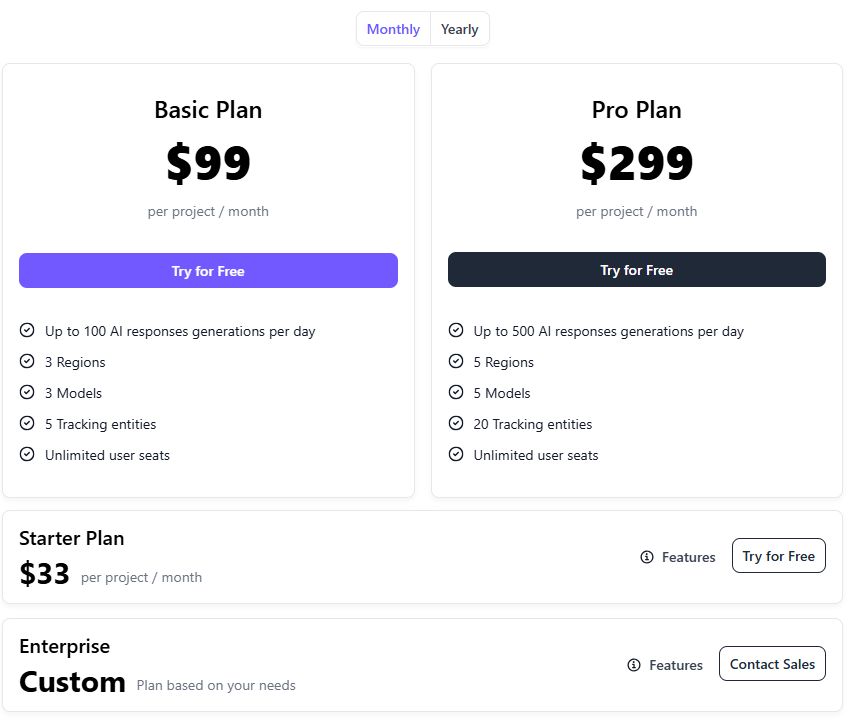
WorkDuo’s project‑based tiers offer unlimited user seats and high daily response limits. Teams are not charged per seat, unlike Writesonic’s Basic plan with only two users. Otterly AI also allows unlimited seats but prompt limits can make multi‑brand tracking expensive.
4. Comprehensive Engine Coverage
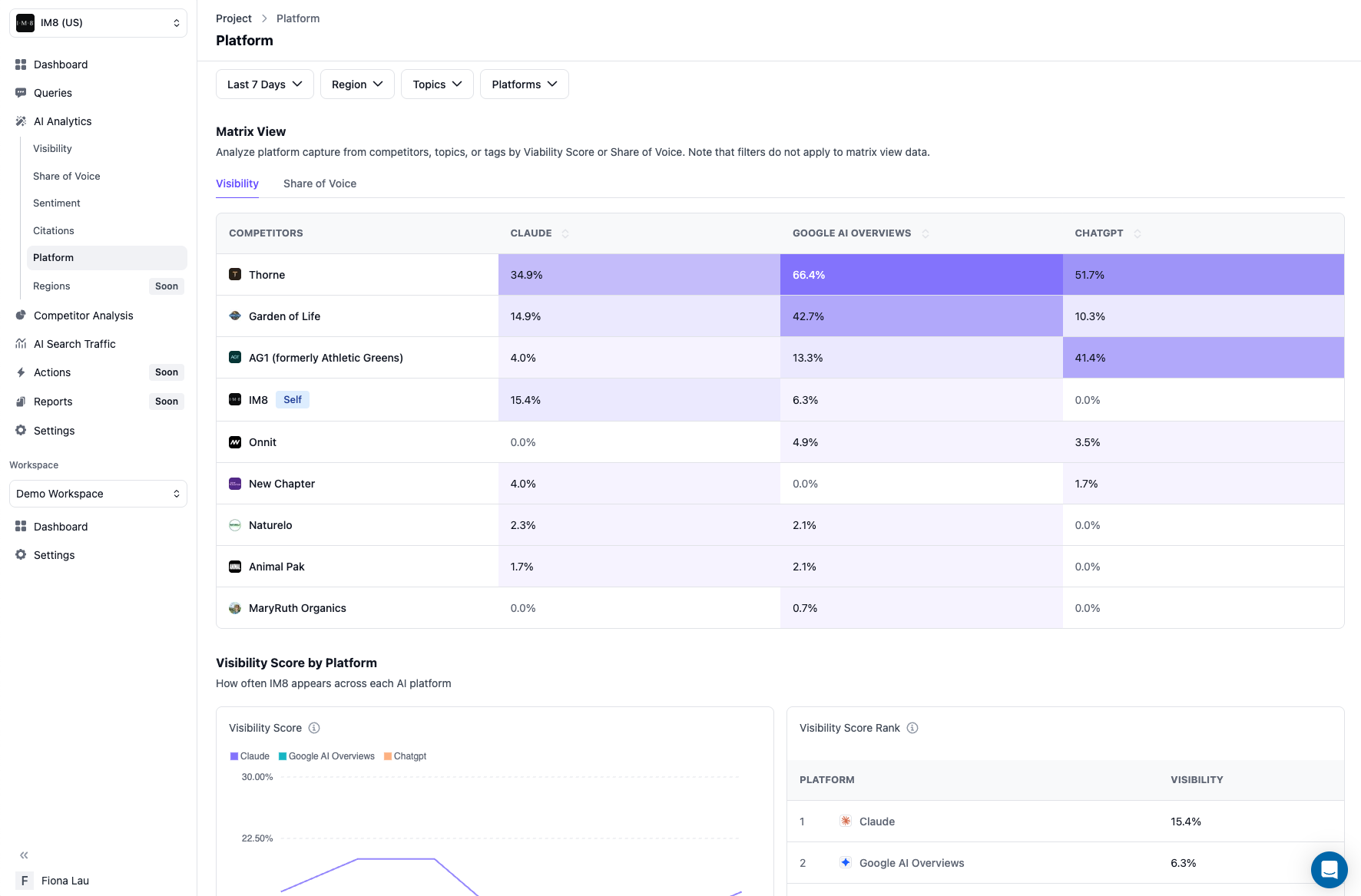
Even at entry level, WorkDuo covers ChatGPT, Perplexity, Gemini, Google AI Overviews/Mode, DeepSeek, Claude and Copilot. Writesonic requires the Enterprise tier for full coverage; Otterly AI offers limited coverage without add‑ons.
5. Agency‑Grade Features
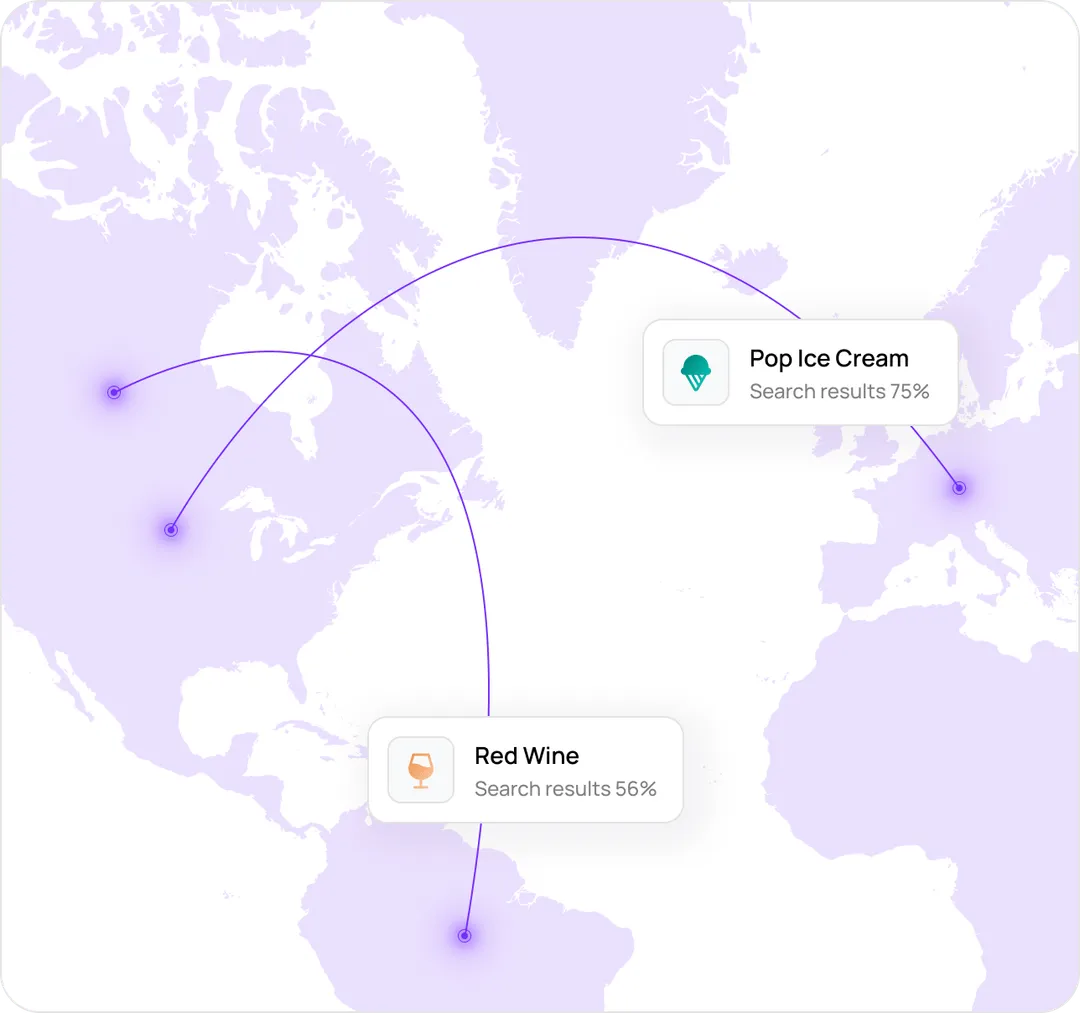
WorkDuo includes competitor benchmarking, white‑label reporting and API access. These features help agencies pitch clients and integrate AI visibility data into custom dashboards, whereas Writesonic and Otterly AI offer minimal agency‑specific tools.
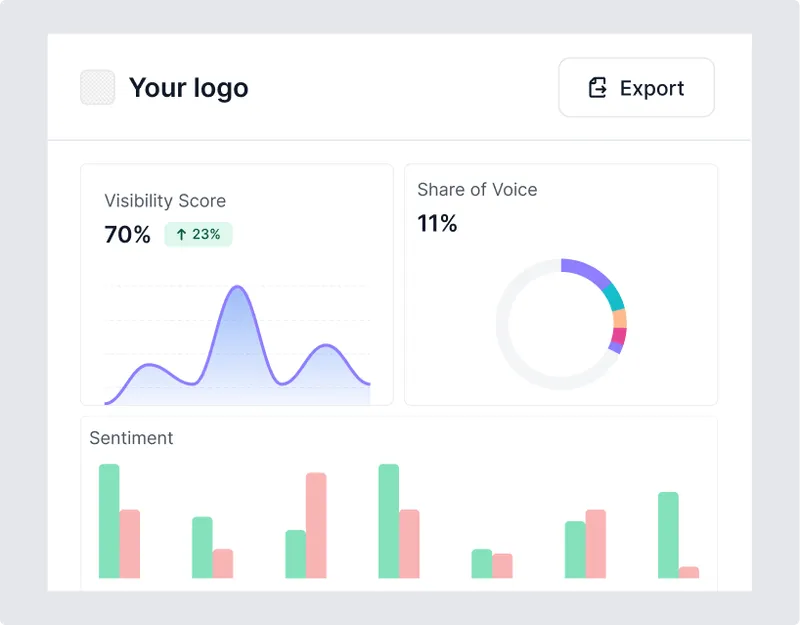
6. WorkDuo’s Lower Cost vs. Writesonic
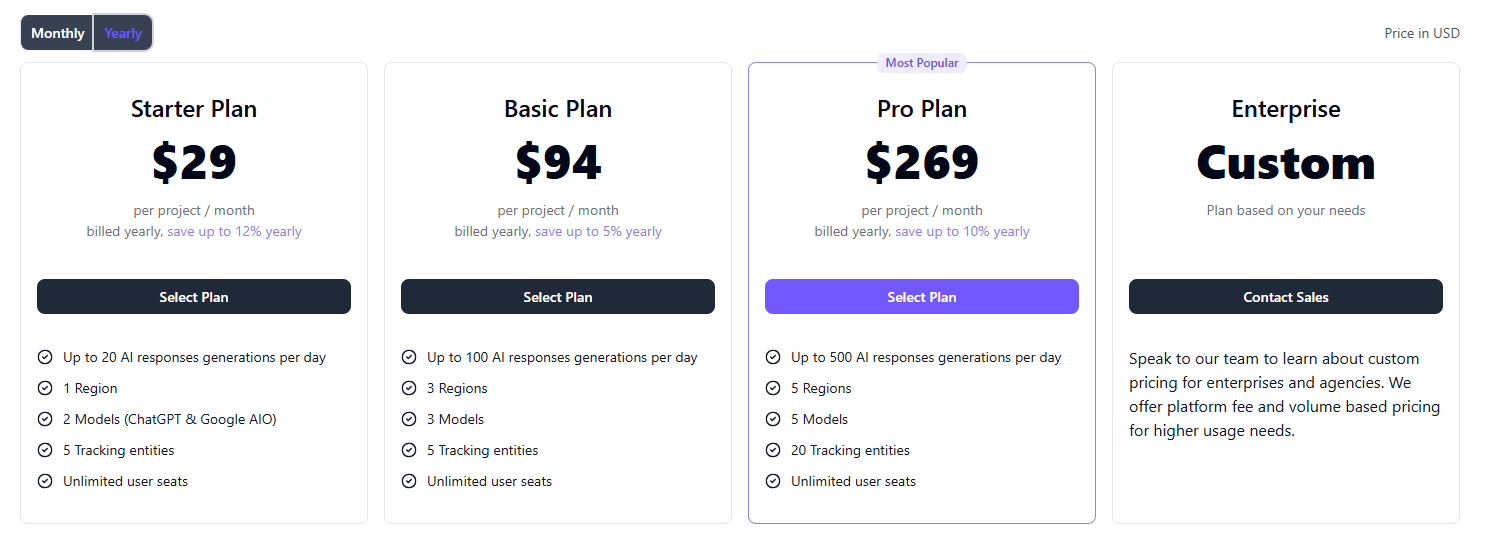
WorkDuo’s starter plan begins at $33 per project per month or $29 per project per month (Annual payment), with unlimited seats and high daily response limits.
In contrast, Writesonic’s GEO features are only available on the Basic tier, which costs $249 per month, offers just two users and two projects, and tracks 100 prompts per month.
Writesonic vs Otterly AI: Price
Price often plays a big role, so let’s put both tools side by side and see which one gives you more for the money.
Writesonic Pricing
Writesonic offers three plans with SEO and AI content tools.
Otterly AI Pricing
Otterly AI uses the same three pricing plans for both brands and agencies. Here’s what each one includes.
Verdict
Writesonic is stronger if you want an all-in-one platform that combines GEO tracking with content creation, SEO tools, and workflow automation in one place.
Otterly AI is the better choice if your priority is cost-efficient, scalable AI visibility tracking with deeper GEO analytics and multi-market coverage.
Writesonic vs Otterly AI: Ease of Use
Let’s compare both tools and see which one feels easier to put into day-to-day use.
Writesonic: Ease of Use
Writesonic comes across as easy to use for content creation, and users consistently describe it as straightforward for generating drafts quickly across different formats and workflows.
It has an intuitive setup flow for configuring AI visibility tracking, which supports the idea that teams can get started without too much friction.
That said, Writesonic’s own GEO documentation notes that the dashboard can feel confusing at first because of the number of metrics and pages, so it seems easiest for teams once they get familiar with where everything lives.
Otterly AI: Ease of Use
Otterly AI appears simpler to pick up right away, with users repeatedly describing setup as easy, onboarding as smooth, and the interface as intuitive for daily tracking work.
Its product flow is built around quick prompt setup and fast report generation, which reinforces its lighter and more monitoring-focused feel.
There is still a small learning curve around understanding some metrics, alerts, and denser dashboards, but overall it looks more immediately approachable than a broader all-in-one platform.
Writesonic vs Otterly AI Ease of Use Verdict
If ease of use is the main deciding factor, Otterly AI has the edge because it appears quicker to understand and easier to get value from early on. Writesonic is still user-friendly, but it looks better suited to teams that do not mind a bit more interface depth in exchange for a broader mix of writing, SEO, and AI visibility features.
Writesonic vs Otterly AI: Customer Support
These support differences can make it easier to judge which platform is more likely to support your team effectively after sign-up.
Writesonic: Customer Support
Writesonic’s support looks fairly strong, with a mix of self-serve documentation and direct help channels built into the product experience. Its docs repeatedly point users to support by email and to the chat function inside the dashboard, while the onboarding flow is described as suitable for both beginners and more experienced users.
For larger customers, Writesonic also lists a dedicated account manager, strategist, and white-glove onboarding on enterprise plans, so its support appears to become more hands-on as teams scale.
Otterly AI: Customer Support
Otterly AI’s support looks practical and easy to access, especially for teams that prefer a lighter, product-led setup. Its public help center covers support, demos, and onboarding, and Otterly AIsays users can reach support by email with a stated response target of within 24 hours on business days.
It also offers onboarding guides, chatbot help, live chat, and contact options tied to setup help, which makes the support feel responsive without being overly enterprise-heavy.
Writesonice vs Otterly AI Customer Support Verdict
If customer support is the deciding factor, Writesonic looks stronger for teams that may want more layered support as they grow, especially with enterprise-style onboarding and account coverage. Otterly AI still looks very solid, but it seems better suited to teams that want fast, accessible help in a simpler, more self-serve support model.
Writesonic vs Otterly AI: Integrations
When manual work is something you want to minimize, integrations can have a big impact on how easily a tool fits into your workflow. These differences can help show which platform may slot more smoothly into your existing stack.
Writesonic: Integrations
Writesonic shows a broader integration setup across CDN and edge logging, CMS, reporting, APIs, and content import workflows, so it fits better into teams that want AI visibility data tied to both infrastructure and content operations.
- CDN and edge logging: Cloudflare, CloudFront, Fastly, Vercel Log Drains, and custom log drains.
- CMS and website platforms: WordPress and Drupal.
- Reporting and BI: Google Looker Studio.
- API access: API dashboard access and Chatsonic API support.
- Content import workflows: PDFs, Word documents, URLs, text files, and WordPress content imports.
Otterly AI: Integrations
Otterly AI shows a narrower integration setup that is more focused on reporting, exports, and ecosystem access than on deeper CMS, infrastructure, or API integrations.
- Reporting and BI: Google Looker Studio.
- SEO ecosystem: Semrush App Center.
- Data export: Search prompt exports and citation exports, with full or summary report options.
- API: No public API is currently listed.
- CMS, CDN, and workflow tools: No widely listed native integrations in these categories.
Writesonic vs Otterly AI Integrations Verdict
Writesonic is stronger on integrations because it connects to more parts of a team’s stack, especially infrastructure, CMS, reporting, API, and content workflows. Otterly AI covers reporting and export needs well, but its public integration footprint is much lighter.
Other-Niche-Relevant-Feature
Looking at the core features side by side makes it easier to understand how the two tools differ and where each one stands out.
Writesonic
Visibility and Competitive Benchmarking
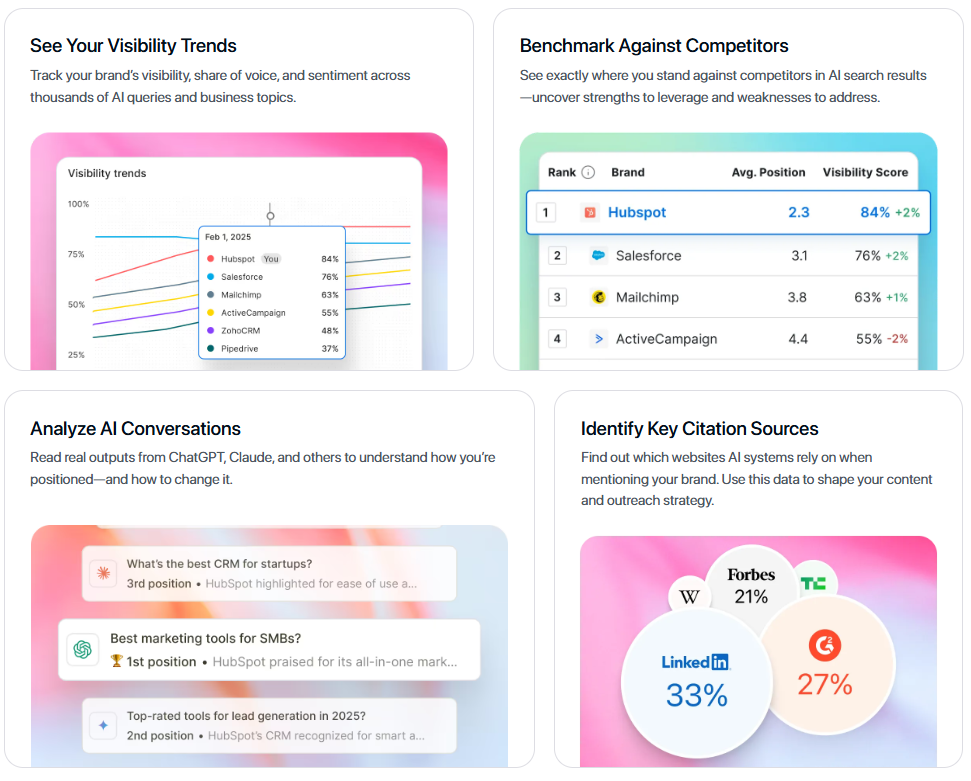
Writesonic’s Brand Presence Explorer is built to show how visible your brand is across AI search, not just whether it appears once or twice.
It tracks visibility trends, share of voice and sentiment across thousands of AI queries and business topics, then compares your performance directly against competitors so you can see where you lead, where you lag and what needs attention first.
Conversation and Citation Insights
This feature helps you move beyond surface-level tracking. Writesonic shows real outputs from ChatGPT, Claude and other AI systems so you can understand how your brand is actually being described in answers.
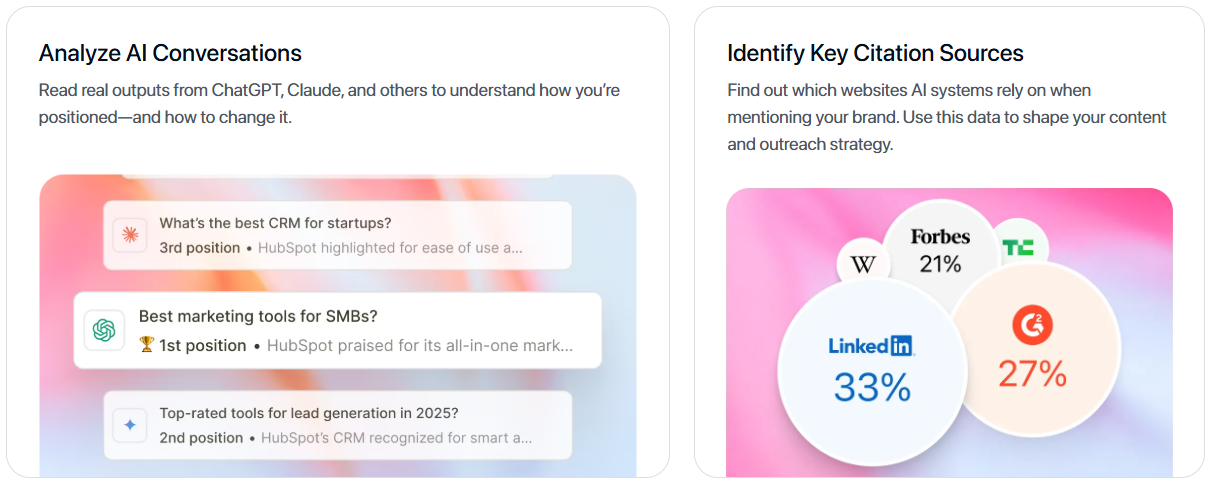
It also identifies the websites and sources those AI systems rely on when mentioning your brand, which makes it easier to shape both your content plan and your outreach strategy.
Actionable Suggestions and Custom Tracking
Writesonic does more than show data. Its GEO platform includes instant optimization suggestions designed to improve visibility, influence AI answers and close content gaps.
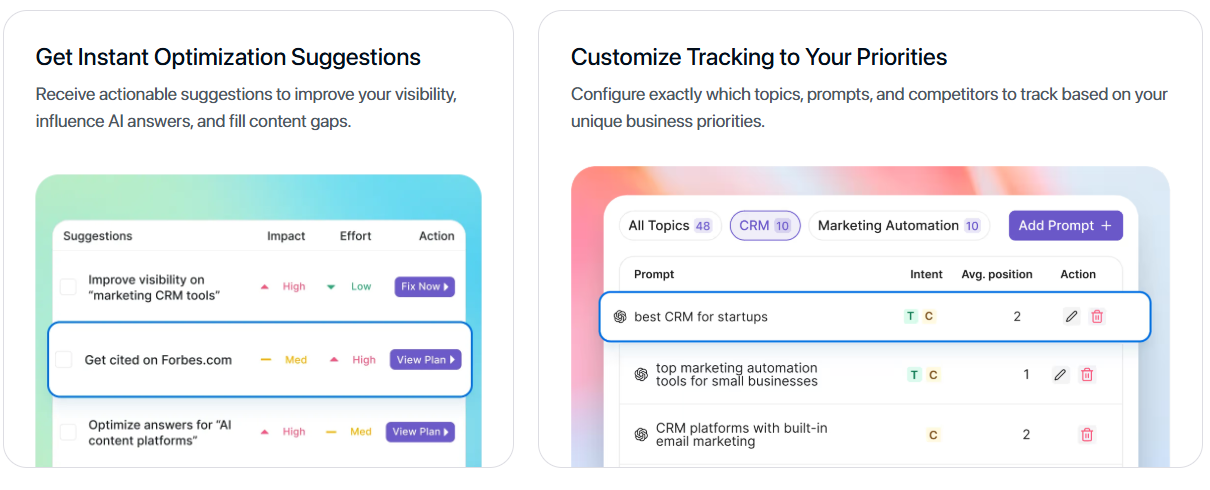
On top of that, you can customize tracking around the topics, prompts and competitors that matter most to your business, which makes the recommendations more relevant and easier to act on in day-to-day workflows.
AI Traffic Analytics
Writesonic’s AI Traffic Analytics is meant to uncover visits that traditional analytics tools can miss.
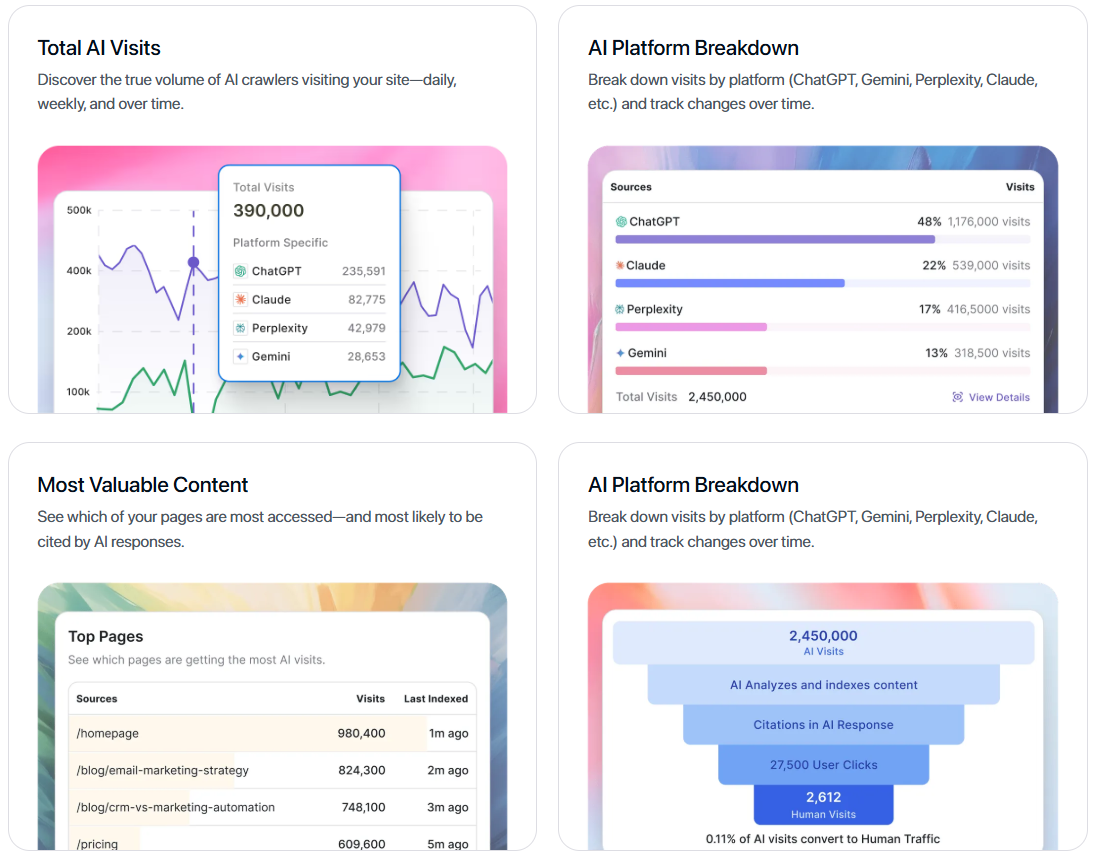
It shows the total volume of AI crawler visits over time, breaks those visits down by platform such as: ChatGPT, Gemini, Perplexity and Claude, and highlights which pages on your site are most accessed and most likely to be cited in AI responses. That gives teams a clearer view of what AI systems value.
Shopping Visibility
Writesonic also extends GEO into product discovery. Its shopping visibility feature helps brands see how products appear in AI-generated shopping results, including environments like ChatGPT Shopping.
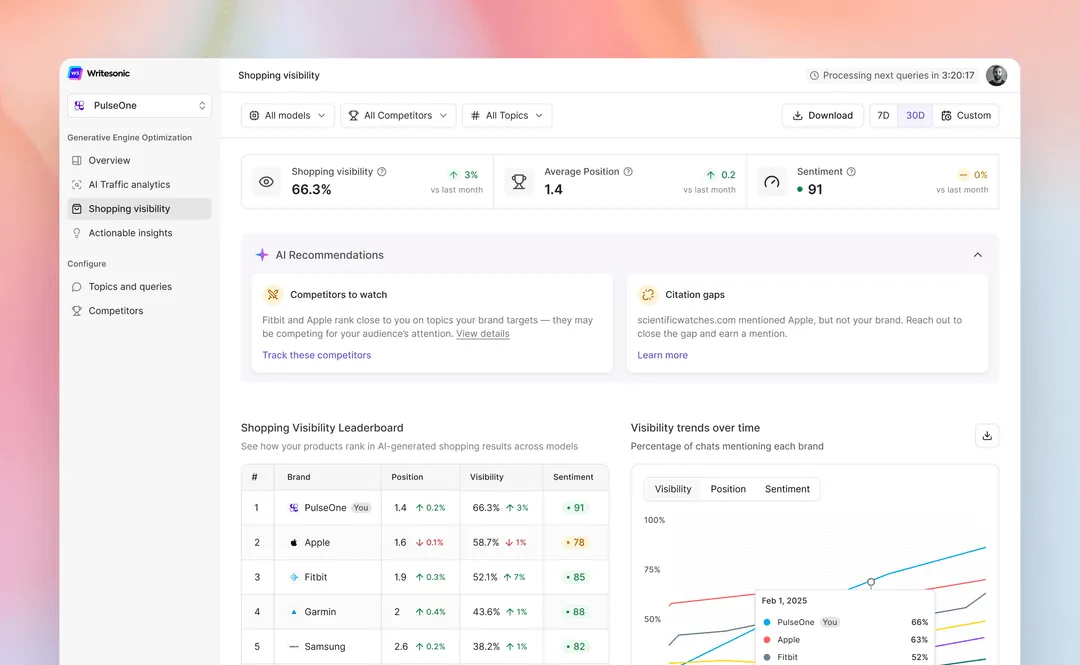
The platform focuses on improving product placement and driving more traffic and conversions, while the on-page interface shown on the official page includes shopping visibility metrics, average position, sentiment, competitor watching and citation gap prompts.
Multi-Platform Coverage
Writesonic positions this as a cross-platform visibility tool rather than a single-engine tracker.

It monitors major AI search platforms including ChatGPT, Google AI Overviews, Claude AI, Perplexity, Google Gemini, Microsoft Copilot and Meta AI in one dashboard. It also says new AI search platforms are added automatically, which helps keep tracking current as the market changes.
Complete Workflow
One of Writesonic’s strongest selling points is that it connects the full GEO process in one platform.
The workflow covers:
- Discover: AI Traffic Analytics shows what content AI systems value.
- Compare: Brand Presence Explorer benchmarks your visibility against competitors.
- Optimize: AI-specific recommendations highlight what to improve next.
- Create: Built-in AI SEO and content tools help you produce content.
- Measure: You can track crawler activity and brand mentions over time.
Otterly AI
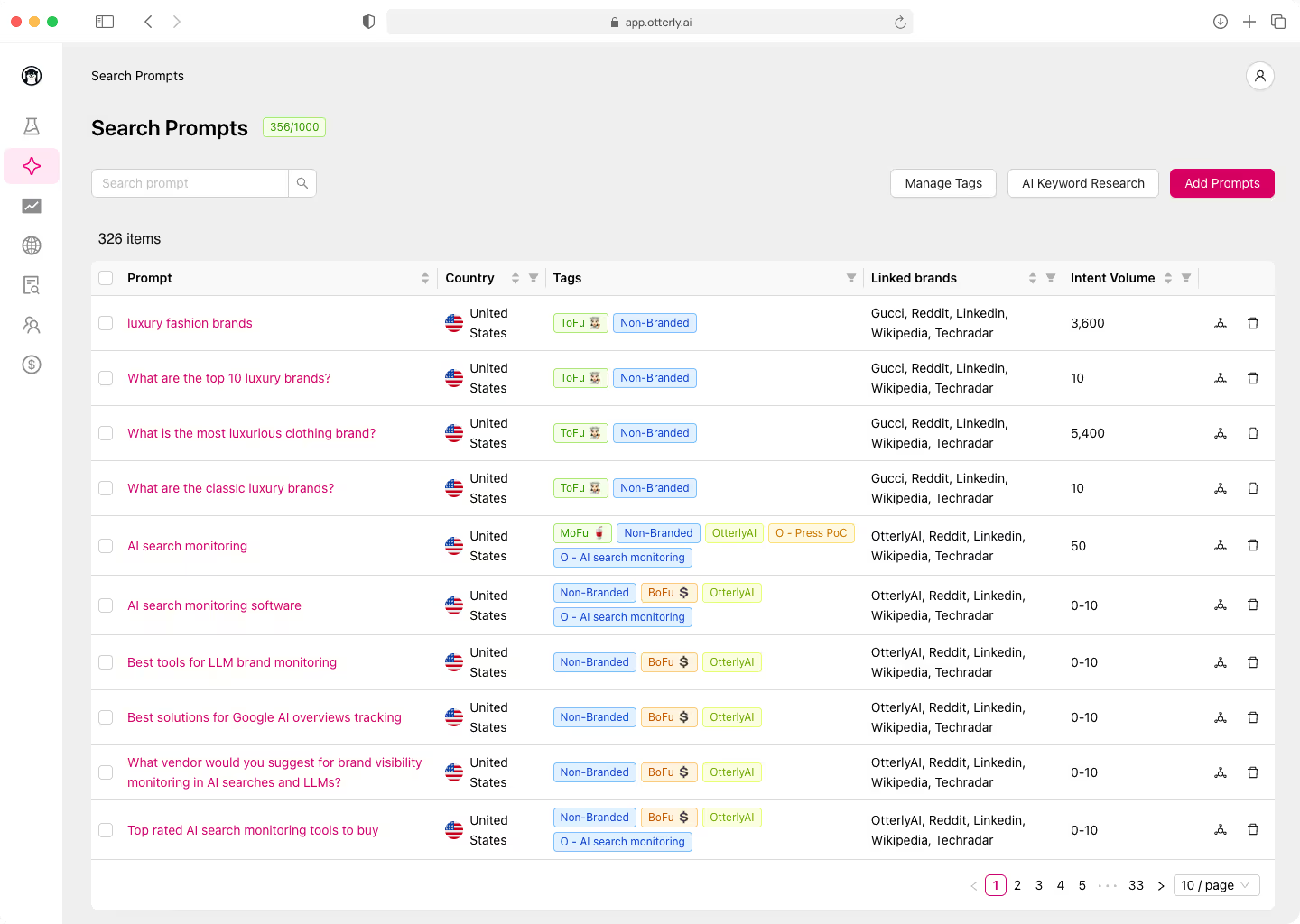
AI Prompt Research & Search Monitoring
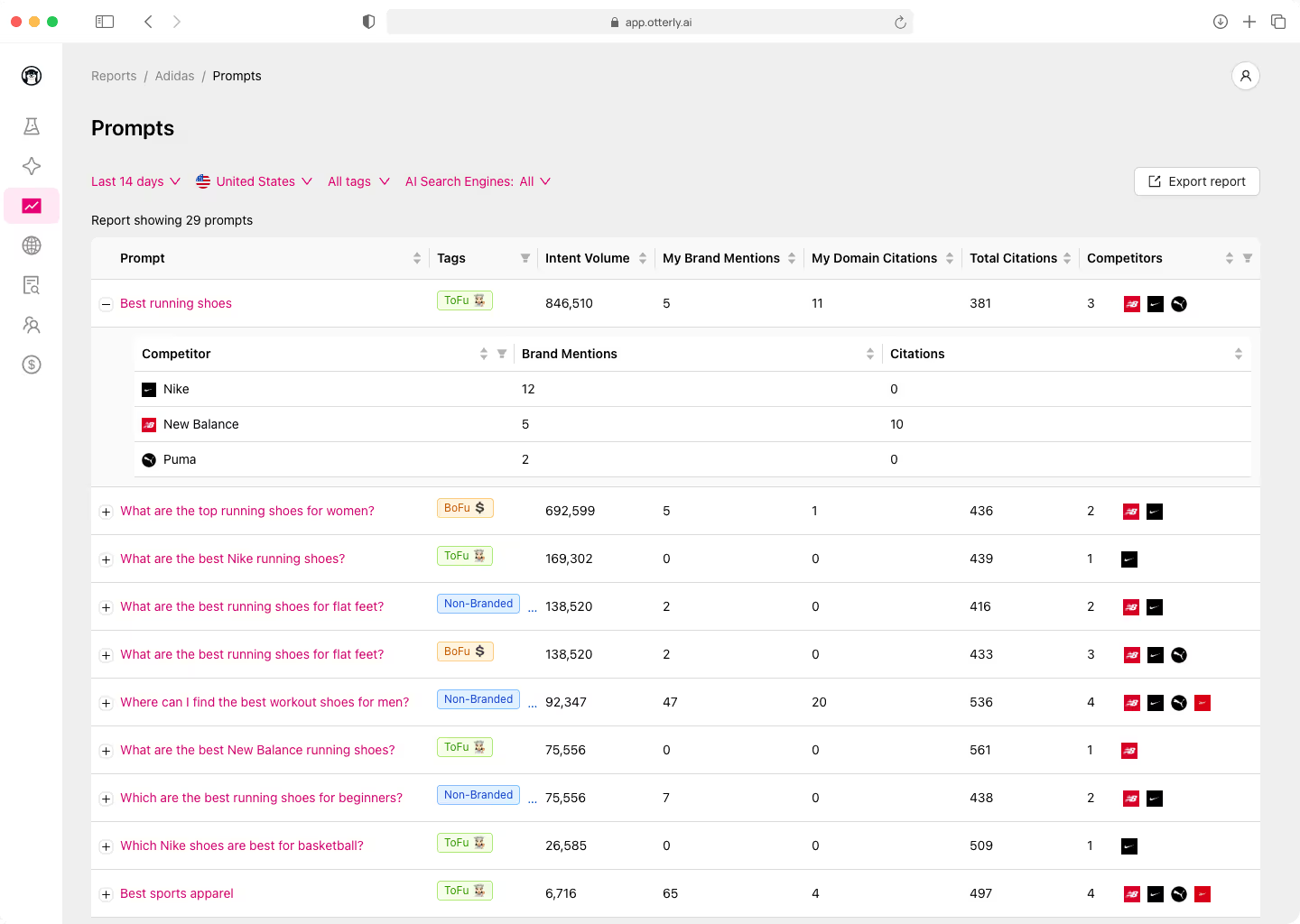
Otterly AI includes AI Prompt Research tools that generate realistic prompts for brand tracking and a Search Prompt Monitoring feature that observes AI responses to those prompts across multiple engines.
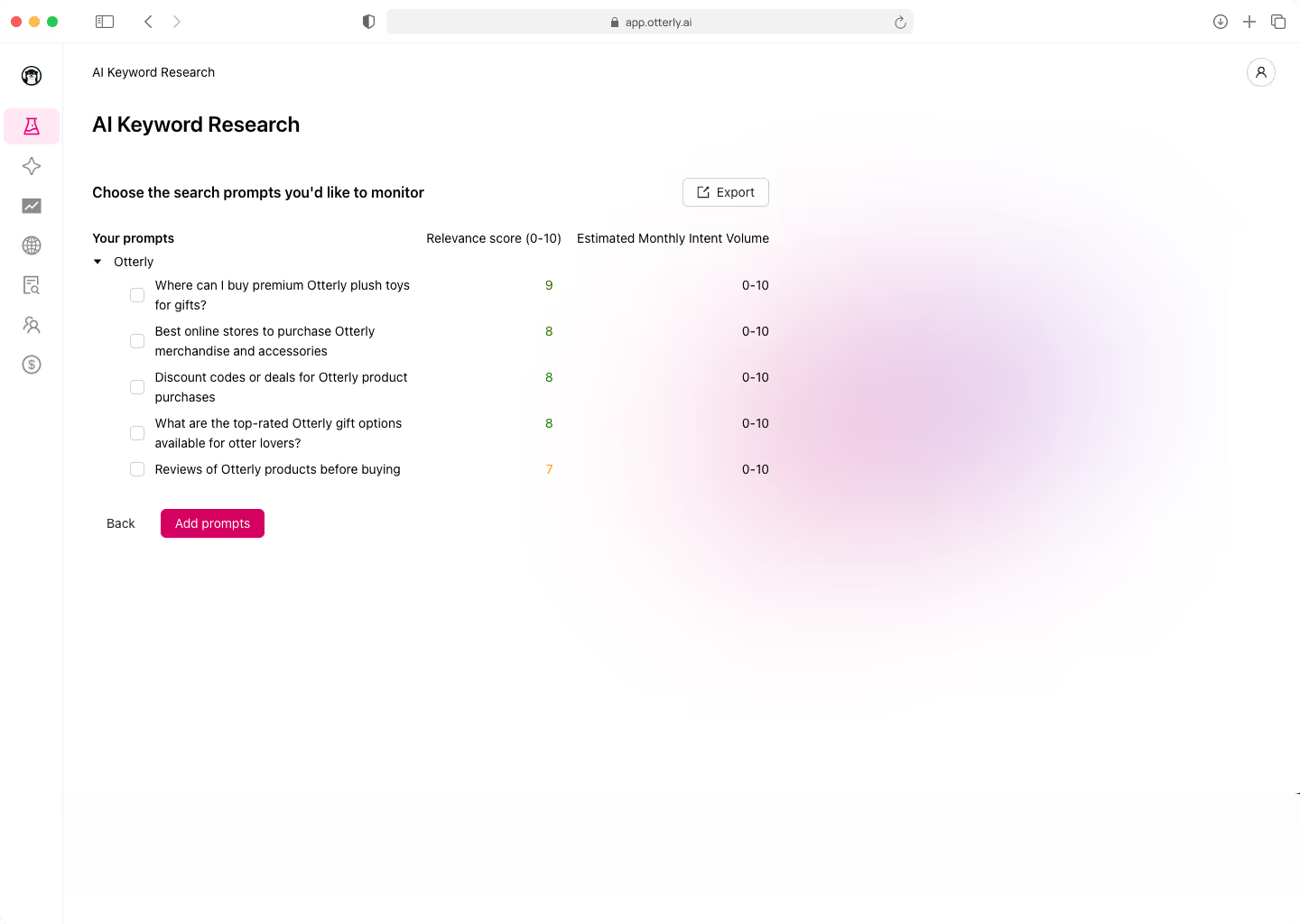
Users can see which queries drive visibility and identify trends in how generative engines respond, making it easier to tailor content strategies for AI search optimization.
Brand Reports & Visibility/Sentiment Metrics
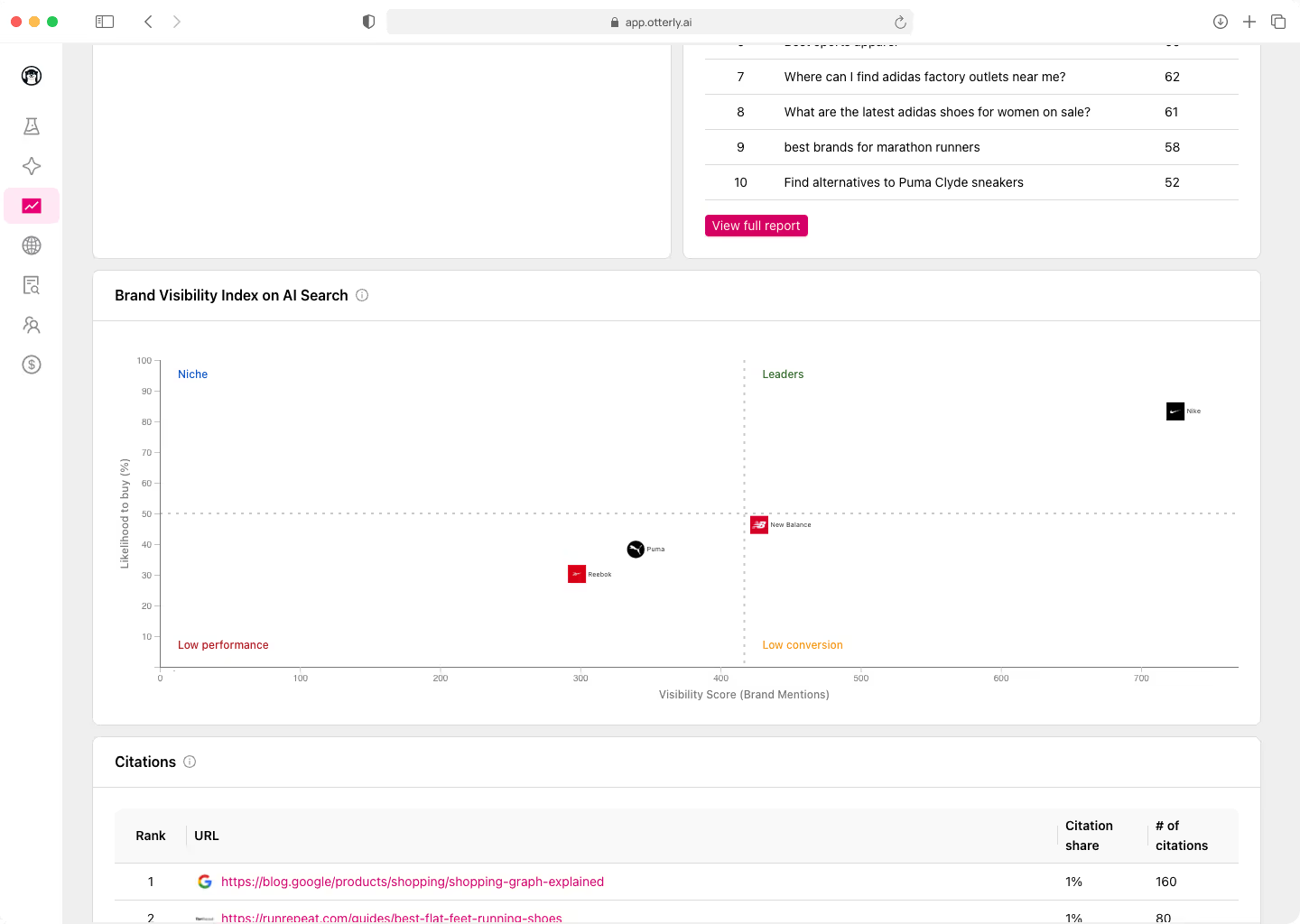
For ongoing measurement, Otterly AI produces Brand Reports summarizing AI‑search visibility over time and a Brand Visibility Index ranking your brand against competitors.
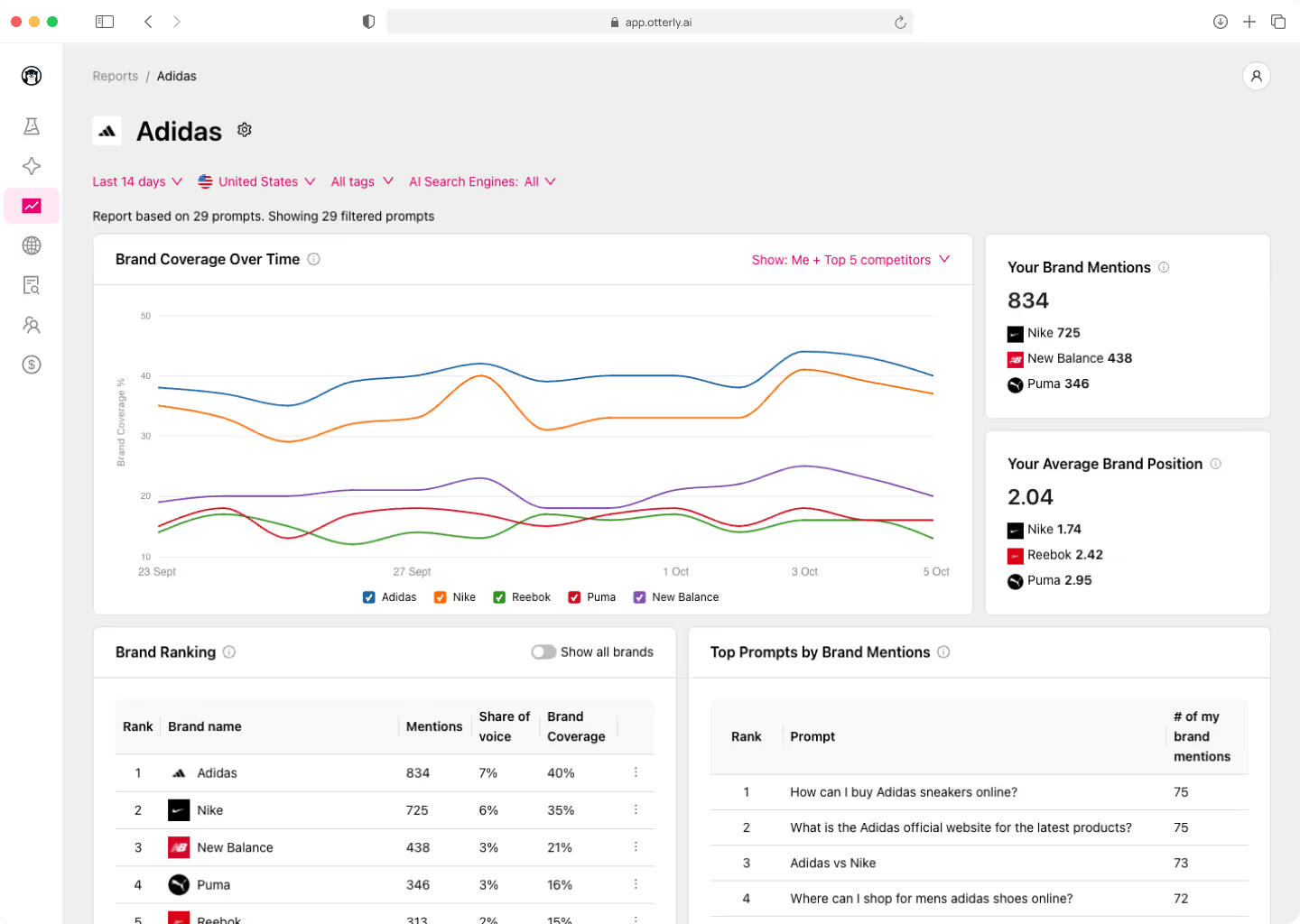
Detailed metrics show how often your domain appears in AI responses, sentiment associated with those mentions and the relative prominence of each appearance, enabling marketers to assess brand health across AI platforms.
Citation Gap Analysis & GEO Audits
The platform conducts Citation Gap Analysis to compare where your brand is cited against competitor citations, flagging missing references that represent opportunities for outreach and content creation.
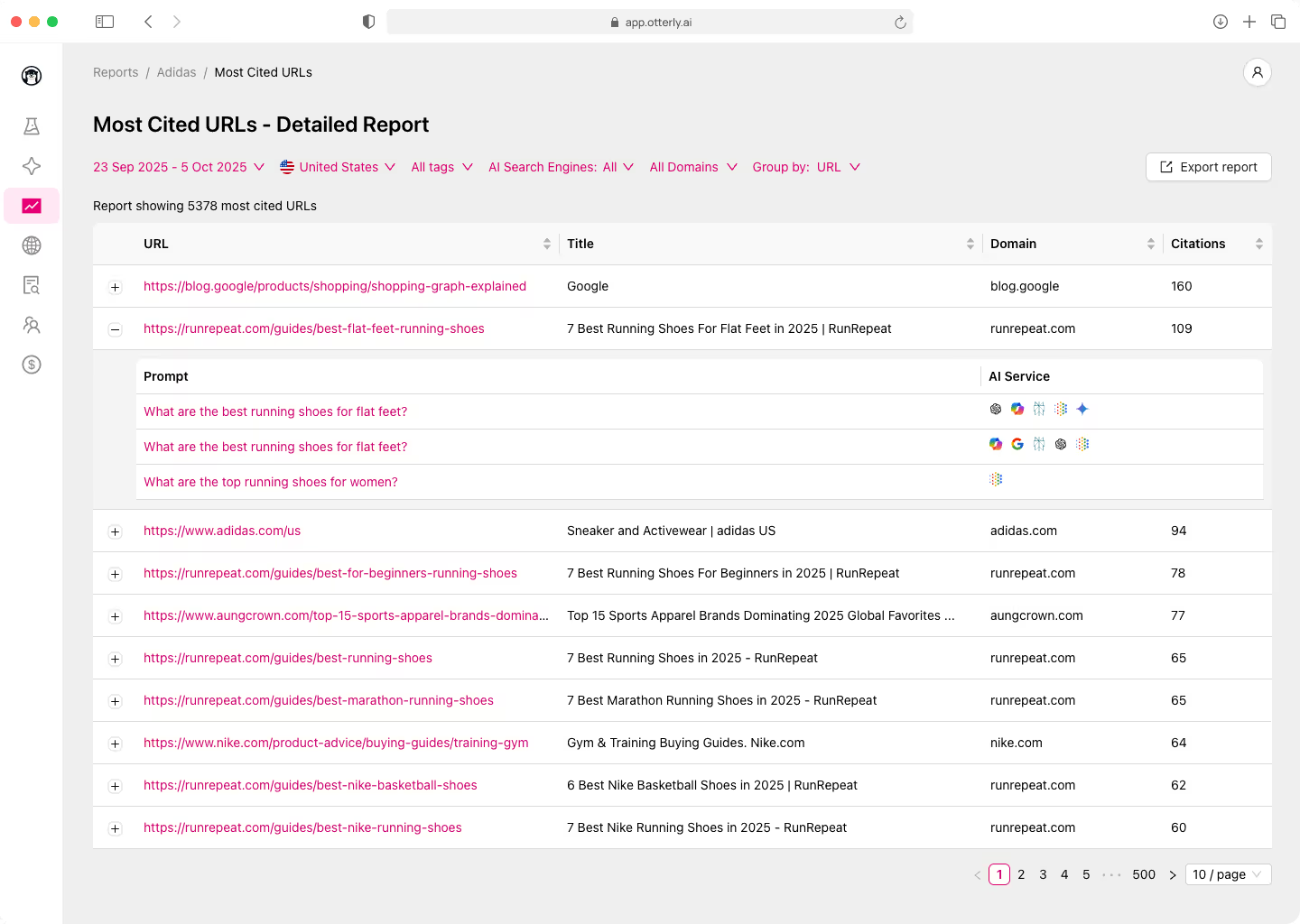
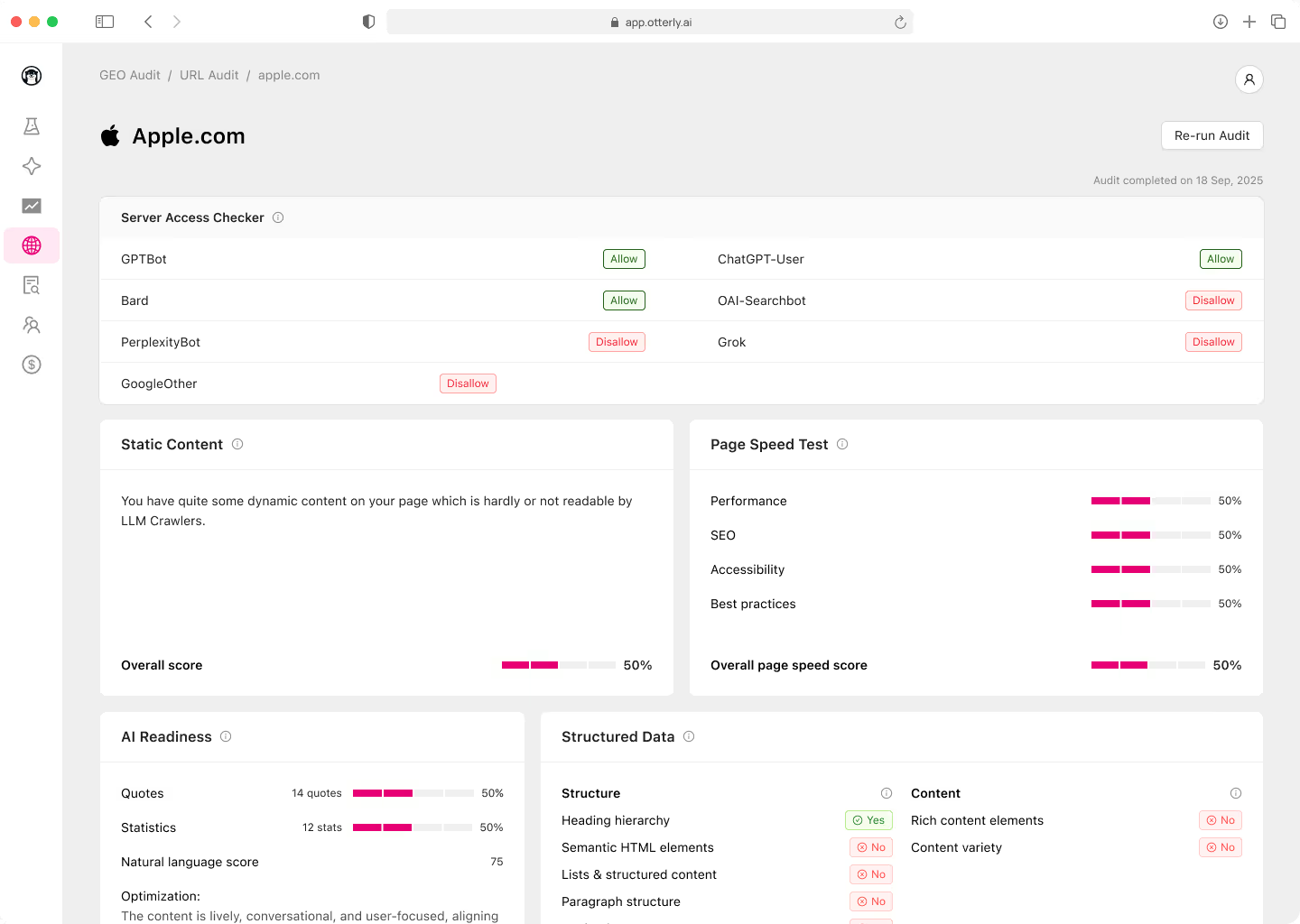
GEO audits evaluate generative engine optimization performance by analyzing AI‑search snippets and user personas, helping users understand how their content is surfaced and how to improve prominence in AI‑driven results.
Workspaces & Multi‑Engine Coverage
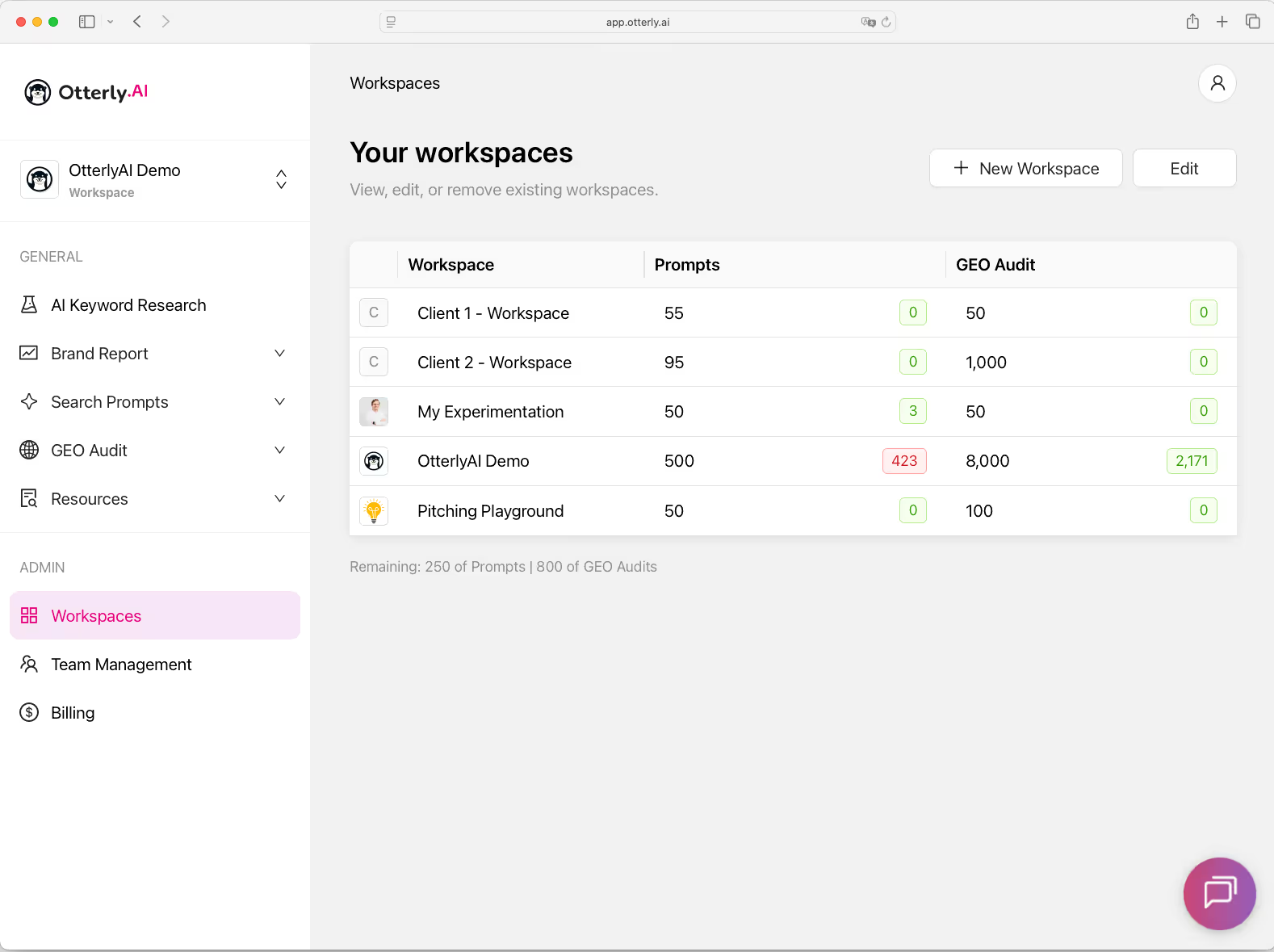
Otterly AI offers workspaces that let agencies manage multiple clients while ensuring each client can only see their own data.
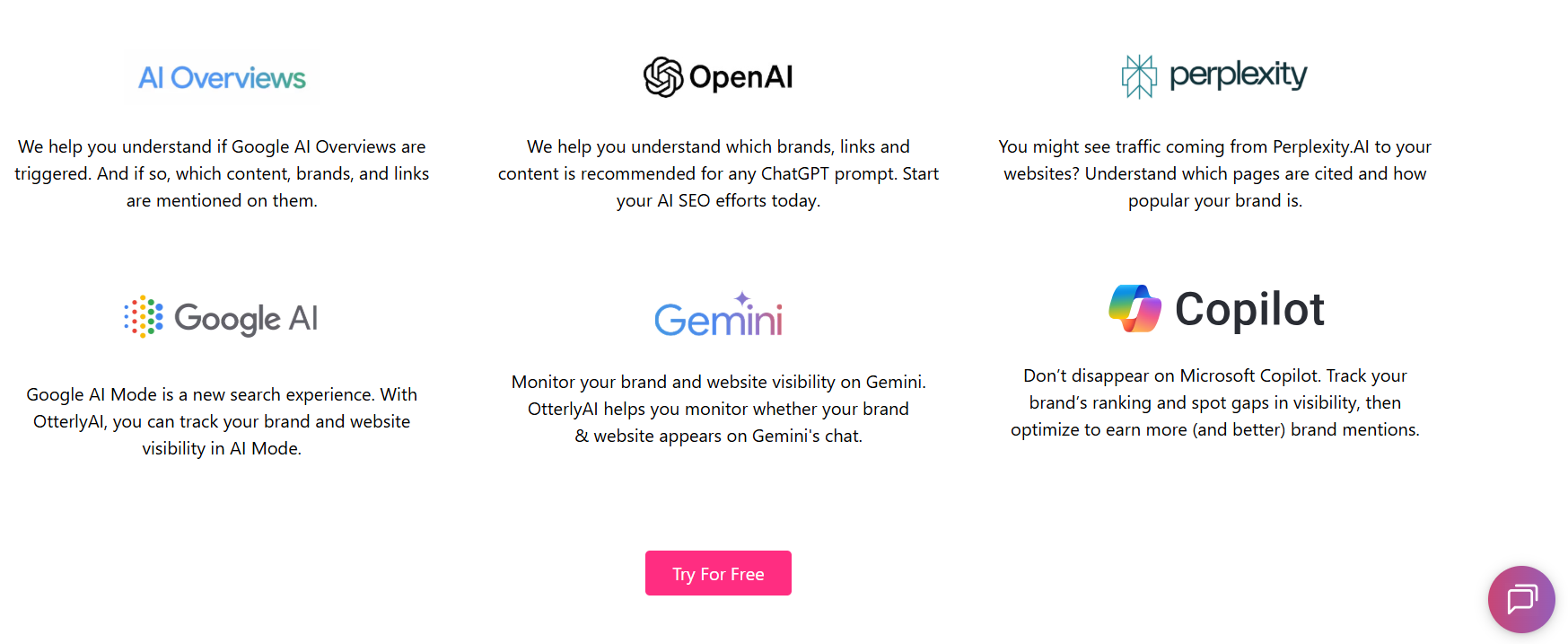
The platform tracks brand visibility across major AI systems like ChatGPT, Google AIO, Perplexity and Claude, providing automated tracking of citations and sentiment across these engines. This ensures a holistic view of AI search performance with tools for reporting and collaboration.
Reporting & Integrations
Otterly AI offers detailed reporting and export options that make it easier to analyze performance outside the platform. You can export prompts, mentions, and citations as CSV files for deeper analysis or internal reporting.
It also includes a Google Looker Studio connector, which helps teams bring AI visibility data into custom dashboards and automated reports.
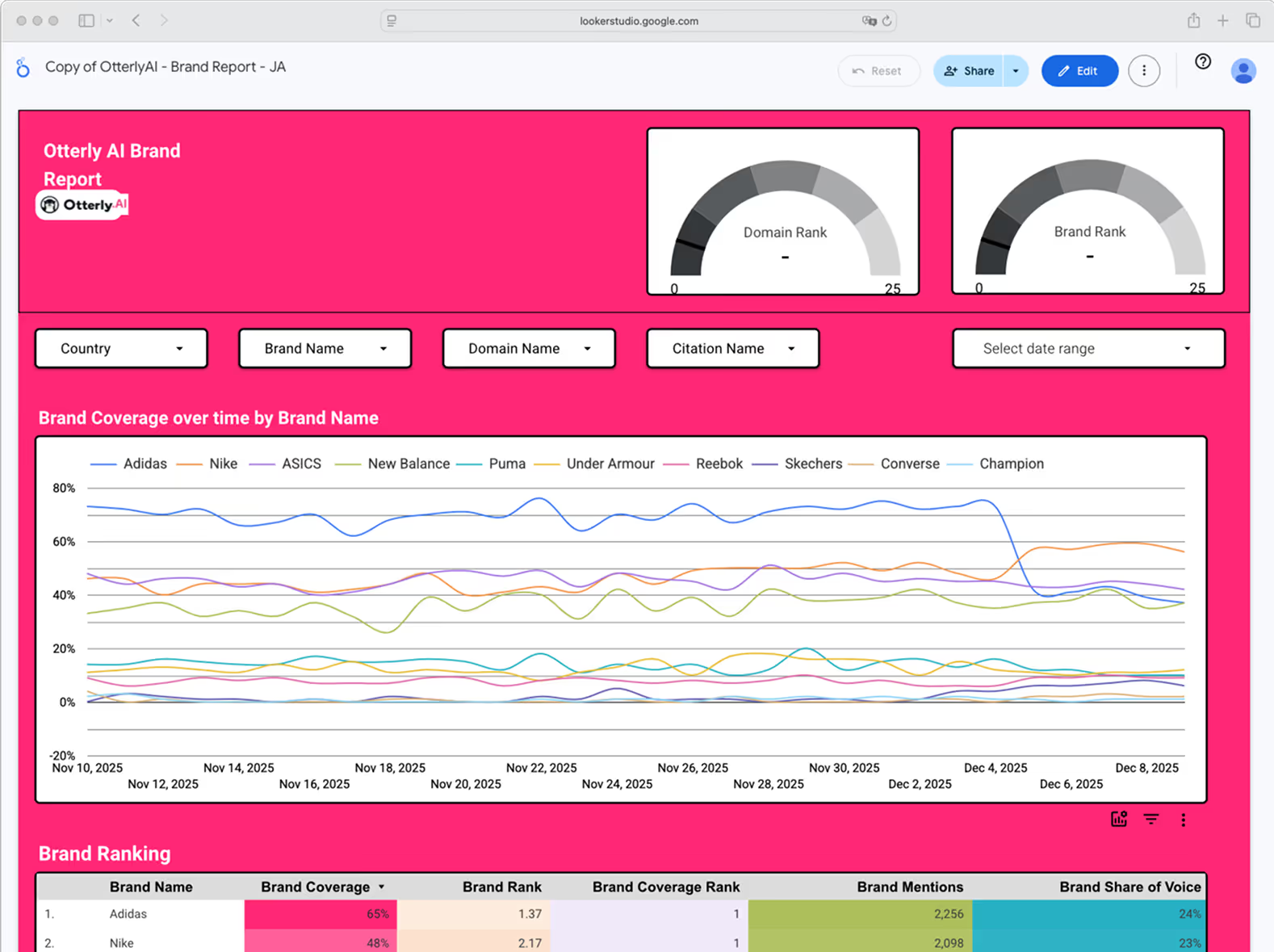
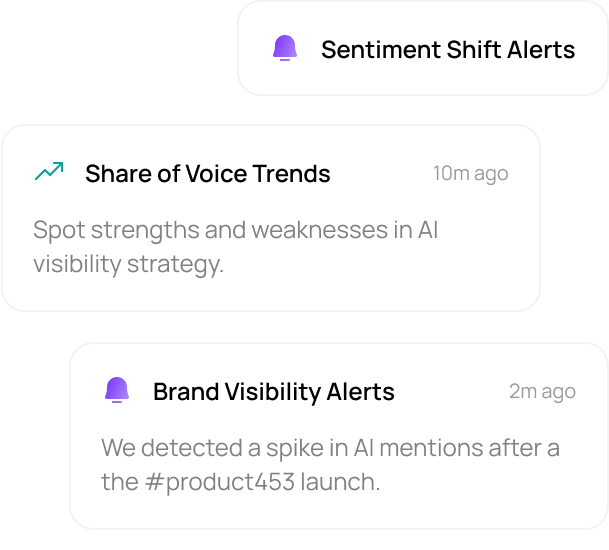
In addition, Otterly AI sends weekly email digests, giving users a simple way to stay updated on changes and performance trends without checking the platform manually.
Verdict
Writesonic is the stronger pick if you want an all-in-one platform that not only tracks AI visibility, but also helps you optimize, create, and measure content in one workflow. Otterly AI is a better fit if your priority is simpler AI search monitoring, reporting, and agency-friendly workspace management without the broader content and optimization layer
How to Choose an AI Visibility Software
These are some of the key criteria to keep in mind when choosing an AI visibility tool.
1. Prioritise Tools That Reflect Real AI Search Experiences
Not every GEO platform gathers data the same way. Some rely mainly on LLM APIs, while others capture results from live browser environments. That difference matters because API outputs do not always match the answers real users see across AI search tools.
If accuracy matters, it is worth favoring platforms that track live results. WorkDuo stands out here because its real-time approach gives teams a clearer view of how they actually appear in AI search.
2. Choose Software That Helps You Act on the Data
Strong GEO software should do more than display mentions, rankings and citations. It should also help you interpret those signals and decide what to do next, whether that means improving content, expanding prompt coverage or addressing weak areas of visibility.
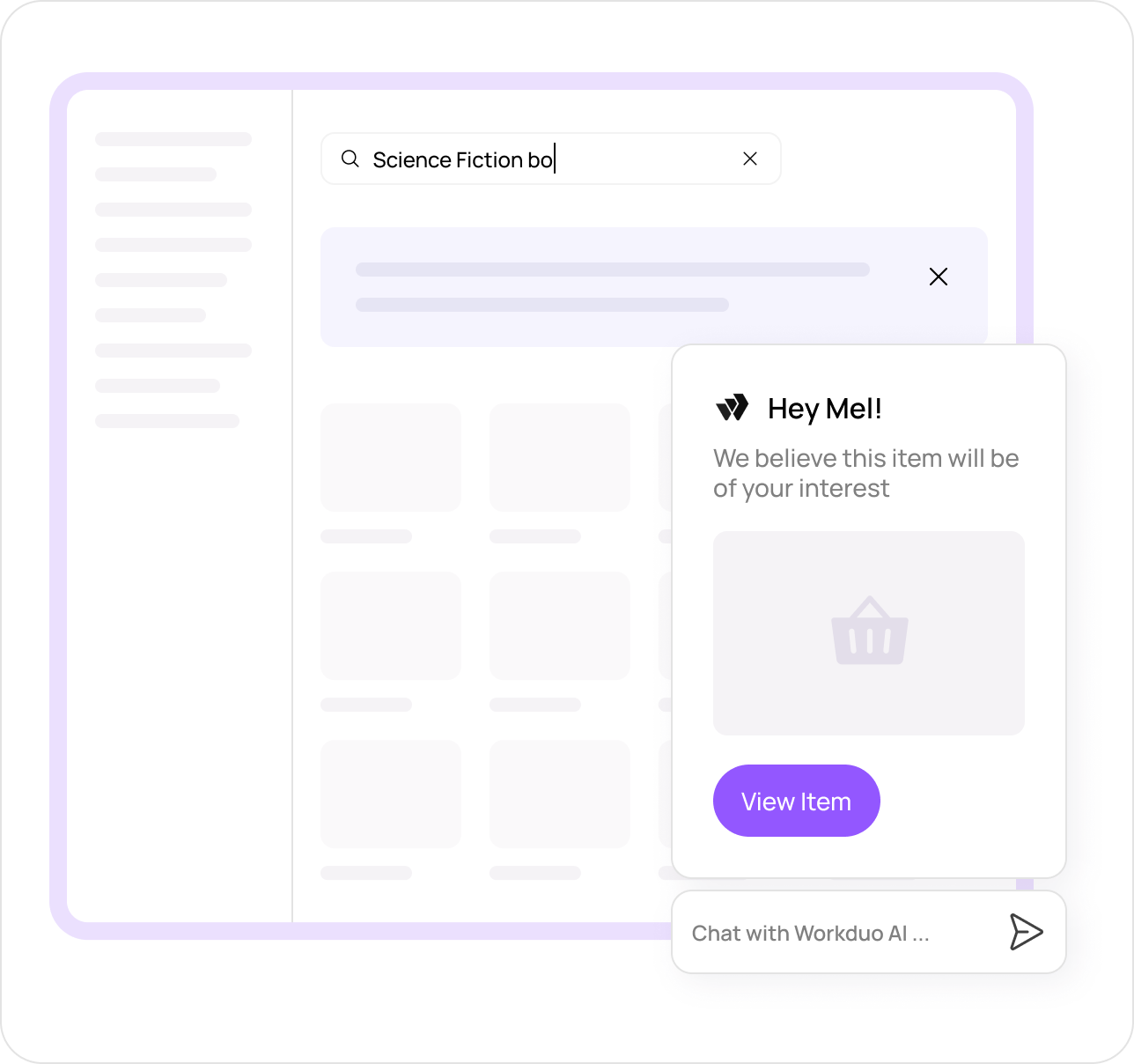
Tools that support decision-making tend to be more useful in everyday workflows. WorkDuo performs well in this area because it is designed to turn visibility data into practical actions.
3. Compare Value Based on Coverage, Not Just Cost
Price alone is not the best way to judge a GEO platform. A better comparison looks at how much tracking depth, model coverage and usable monitoring you actually get for what you pay.
A cheaper plan can still feel limiting if it does not support ongoing work properly. That is why it makes sense to measure value against real usage, and WorkDuo is appealing here because its pricing aligns more closely with practical day-to-day coverage.
4. Look for Flexibility for Brands and Agencies
If you manage multiple brands, internal teams or client accounts, flexibility becomes much more important. Features such as project-based workspaces, custom tracking controls and scalable reporting setups can make it much easier to grow without creating extra complexity.
The best GEO monitoring tools should support both in-house teams and agencies smoothly. WorkDuo is a strong option here because it is built to work across both types of workflows.
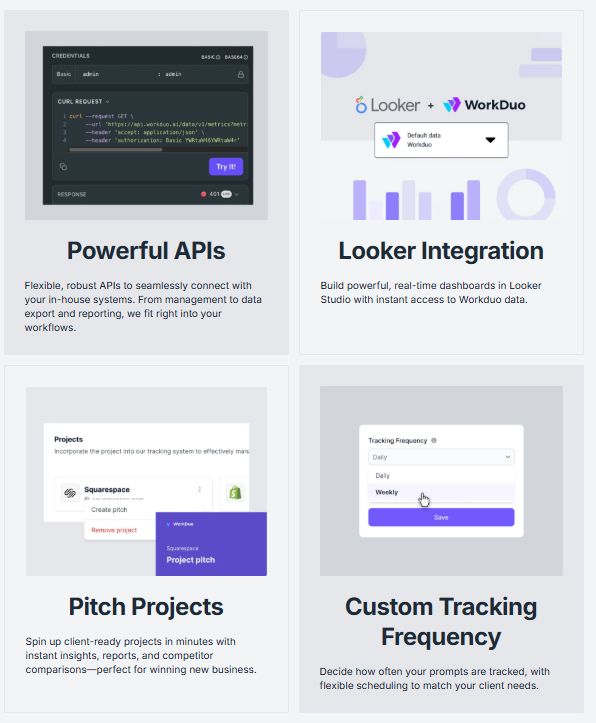
5. Review Market and Regional Coverage Closely
AI search results can vary widely by market, language and region, so coverage should always be part of your evaluation. It is important to check what each plan includes and whether expanding into more locations becomes costly over time.
For businesses operating across multiple markets, this can have a major impact on long-term value. WorkDuo stands out again because it offers broader visibility without forcing teams straight into an expensive premium tier.
Alternative to Writesonic and Otterly AI: WorkDuo
WorkDuo is an AI search visibility platform that tracks how brands appear across major AI engines in real time, with browser-based monitoring, sentiment analysis, competitor benchmarking, and unlimited-seat project pricing.
It is a strong alternative to Writesonic and Otterly AI because it combines broader real-time visibility insights with a much lower entry price than Writesonic’s GEO plans, while also offering deeper analysis and more scalable pricing than Otterly AI’s prompt-based setup.
Key Features
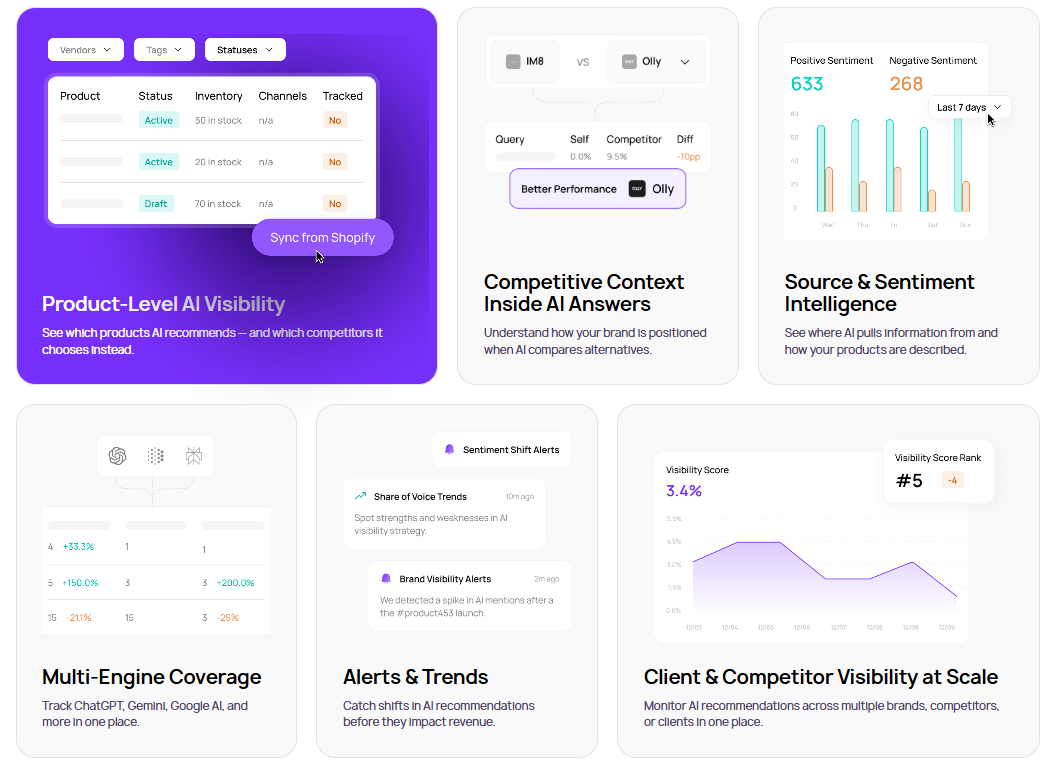
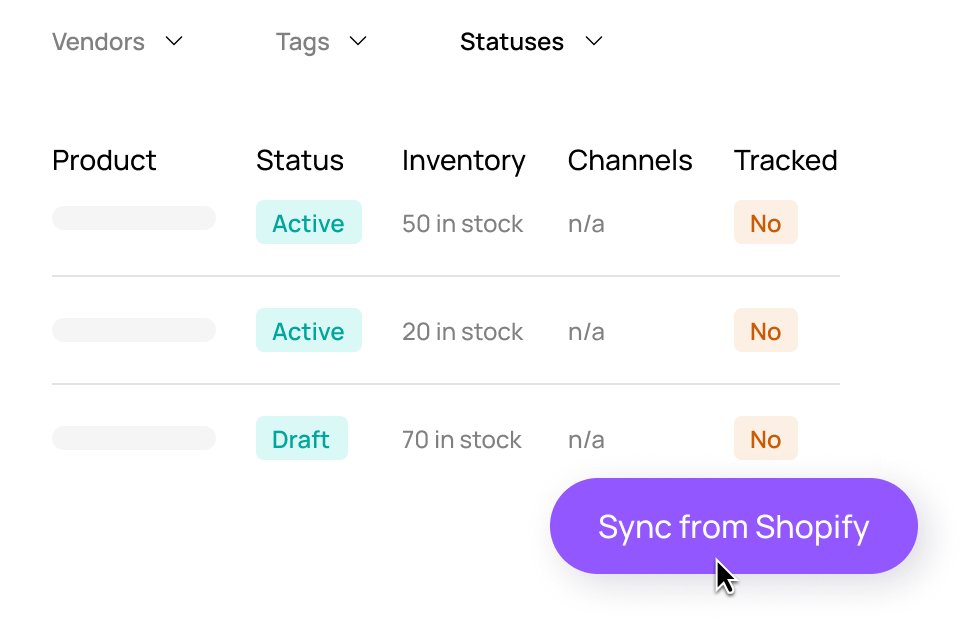
Product-Level AI Visibility
WorkDuo gives teams a clearer view of visibility at the product level, not just the brand level. Instead of only showing whether your company is mentioned, it highlights which products are being recommended and which rival products appear alongside them. That makes it especially useful for e-commerce and product-led teams.
Competitive Context Inside AI Answers
WorkDuo helps you see how AI platforms position your brand when users ask for comparisons or alternatives. This makes it easier to spot whether your product is being recommended strongly, mentioned as one option among many, or pushed behind competitors in key buying moments.
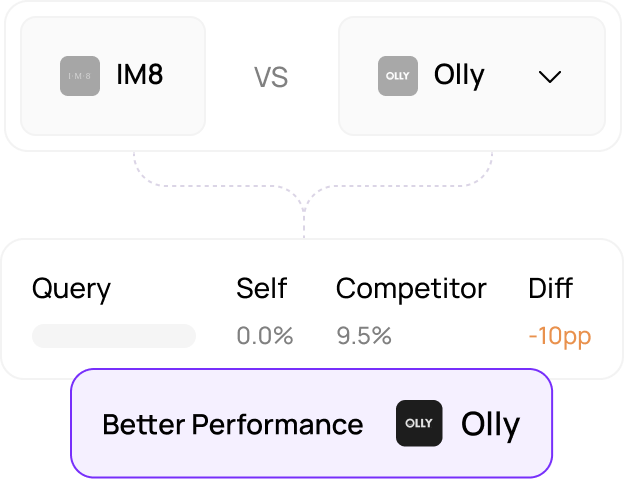
Client and Competitor Visibility Across Multiple Accounts
WorkDuo lets teams track AI visibility for multiple brands, competitors and client accounts from one place. This is particularly useful for agencies and multi-brand businesses that need to compare performance across different products, markets or clients without jumping between separate dashboards.
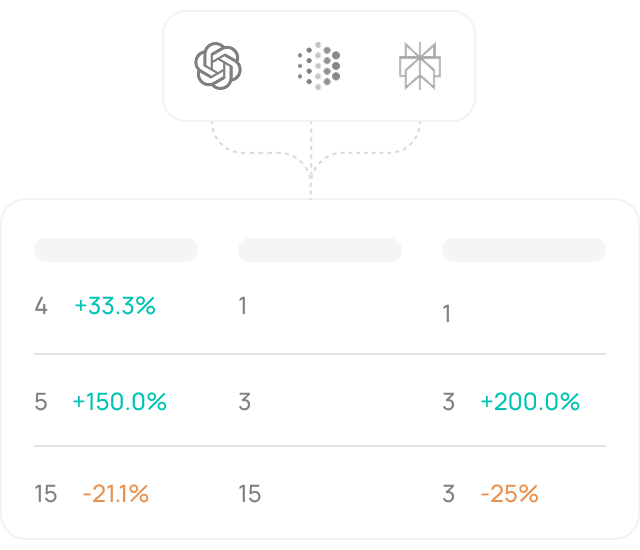
Where WorkDuo Shines
- Project-based pricing flexibility: The pricing structure is more affordable and easier to scale over time, since teams can start small and add more projects as their monitoring needs expand.
- Affordable entry and unlimited seats: Project-based pricing with unlimited users makes the platform more accessible for smaller teams and agencies. Even the higher-tier plans remain more affordable than Writesonic’s $249/month starting price.
- Agency-grade integrations: With API access and white-label options, agencies can create more customised workflows and maintain a branded experience for clients.
Where WorkDuo Falls Short
- Not built for AI content generation: WorkDuo is designed for monitoring, benchmarking and visibility analysis rather than producing large volumes of AI-generated content.
- No direct publishing workflow: It is not built to publish content directly to websites, landing pages or product pages, so teams still need to rely on their existing CMS and publishing workflow.
Who WorkDuo Is Best For
- SMBs that want practical visibility tracking: A solid choice for teams that want useful AI visibility data without committing to a more complex enterprise platform.
- Product and Ecommerce teams: Particularly helpful for teams that need to track visibility at the product, category or offer level rather than only at the brand level.
- SEO and content agencies: Well suited to agencies managing visibility for multiple clients, brands and competitors at once.
- Global brands: Useful for businesses that need to monitor how AI search behaves across different regions, languages and markets from one platform.
Track Your Brand Visibility on AI Search with WorkDuo
If your team needs AI visibility software that is flexible, scalable, and built for real-world use, WorkDuo makes a strong case.
It goes beyond basic mention tracking by helping you understand product visibility, competitive positioning, and how AI engines are actually presenting your brand.
That makes it easier to act on the data instead of just reviewing another dashboard. Start using sharper AI visibility insights to guide your next move with a free trial with WorkDuo.
Fiona is the Co‑Founder of WorkDuo AI, where she helps brands optimize their AI search visibility. Previously, she co‑founded SHOPLINE, a smart commerce platform in Asia, and led its successful exit to a NASDAQ‑listed company in 2022. With deep expertise in scaling tech businesses and working with global investors, Fiona now advises startups on growth and data-driven decision-making, while leading WorkDuo’s mission to improve how brands are represented in AI-driven search.

Ready to try our product?
Sign up for a free consultation with our experts.


Follow Us on Social Media
Follow our profiles for daily updates, behind-the-scenes content, and more.




More articles