AI Search for Ecommerce: How it Works & Benefits
.png)
- How AI search for ecommerce works: Understands shopper intent and matches it to relevant products, even when search wording does not match catalog terms.
- Key benefits: Better product discovery, less search friction, and higher conversion from high-intent search traffic.
- How to optimize for AI search: Align product data and discovery with how customers actually search to improve visibility and scale performance.
Product discovery is shifting fast. More shoppers now describe what they need and expect clear, useful results without digging through pages of links.
According to a 2025 consumer research, 58% of consumers have replaced traditional search engines with generative AI for discovery and decision-making.
This means visibility is no longer guaranteed just because your products rank for keywords.
AI search for ecommerce is how you adapt to this shift. It focuses on:
- Understanding what shoppers are trying to find
- Matching those needs to the right products, and
- Ensuring discovery still works when customers rely on AI-driven experiences
In this guide, we show you how AI search for ecommerce works, the core technologies behind it, and the benefits of optimizing for it. You will also learn what to look for in AI search tools.
Why AI Search Matters for Ecommerce
Ecommerce customers expect search experiences that understand their intent.
According to e-commerce UX research, many ecommerce sites struggle to support common search query types. This is especially so for queries that describe:
- Use cases
- Conditions
- Desired outcomes
Say a shopper searches for “hiking shoes for slippery terrain.” They are not simply looking for keyword matches.
They expect product results that prioritize grip, waterproofing, stability, and outsole material, even if those attributes are not listed in product titles.
When this intent is misunderstood, relevant products will not surface.
AI search matters because it surfaces this by:
- Connecting shopper intent to product attributes
- Helping customers find suitable products without repeated searches
- Improving performance without increasing traffic or discounts
This understanding helps ecommerce teams build visibility into how their products appear in AI-driven searches.
WorkDuo provides that visibility. It helps you see exactly where and how your brand appears, what narratives AI is amplifying, and which sources are driving those answers.
Sign up today and see how this works.
How AI Search Differs from Traditional Keyword Search in E-commerce
AI search adoption is accelerating as businesses move past the pilot stage.
Deloitte’s 2026 State of AI report found that 34% of companies are already using AI to deeply transform their businesses.
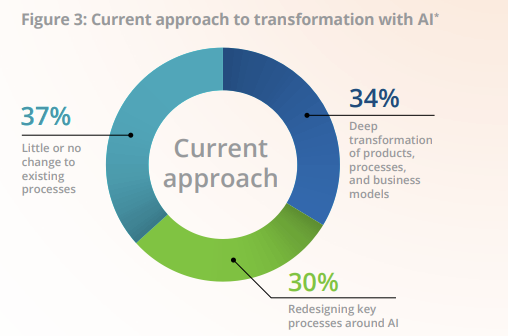
This indicates a shift toward embedding AI in high-impact, customer-facing functions, such as search and product discovery.
Simultaneously, consumer behavior is changing. A McKinsey research shows that 50% of consumers currently use AI-powered search.
AI search is also the most preferred information source when making a purchasing journey.
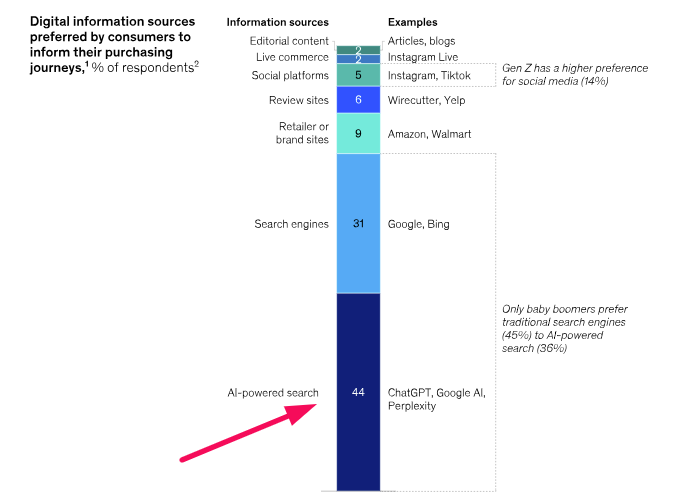
This marks a shift from keyword-driven browsing towards AI-assisted assessment and comparison.
AI-search fundamentally differs from traditional keyword search.
Traditional searches return results based on text matches and fixed rules.
AI search supports intent-led queries and helps consumers transition from discovery to decision with:
- Less reliance on exact wording
- Fewer repeated query refinements
- Greater support during evaluation, not just retrieval
Key Differences Between GEO/AEO and SEO
How AI Search Works in Ecommerce Platforms
AI search for ecommerce relies on a combination of elements to return relevant results based on shopper intent. These include:
- Language understanding
- Ranking systems
- Retrieval methods
- Behavioral signals
- Product data
Here are the common technologies used to populate AI search results
1. Natural Language Processing (NLP)
NLP enables search systems to understand, interpret, and process human language. This happens beyond keyword matching to understand:
- Meaning
- Relationships between words, and
- Implied intent
Example: A shopper searches for “black shoes I can wear to a wedding but still walk in all night.” A basic keyword system might focus only on “black shoes” and return a wide mix of formal shoes, school shoes, and casual footwear.
With NLP, the search engine can interpret the fuller meaning behind the query: colour (black), occasion (wedding), and need (comfortable enough for long wear). Because of that, it can prioritise results such as black low-heel sandals, cushioned formal flats, or dress shoes designed for comfort.
This allows ecommerce platforms to return more relevant products even when shoppers do not know the exact product name or attributes.
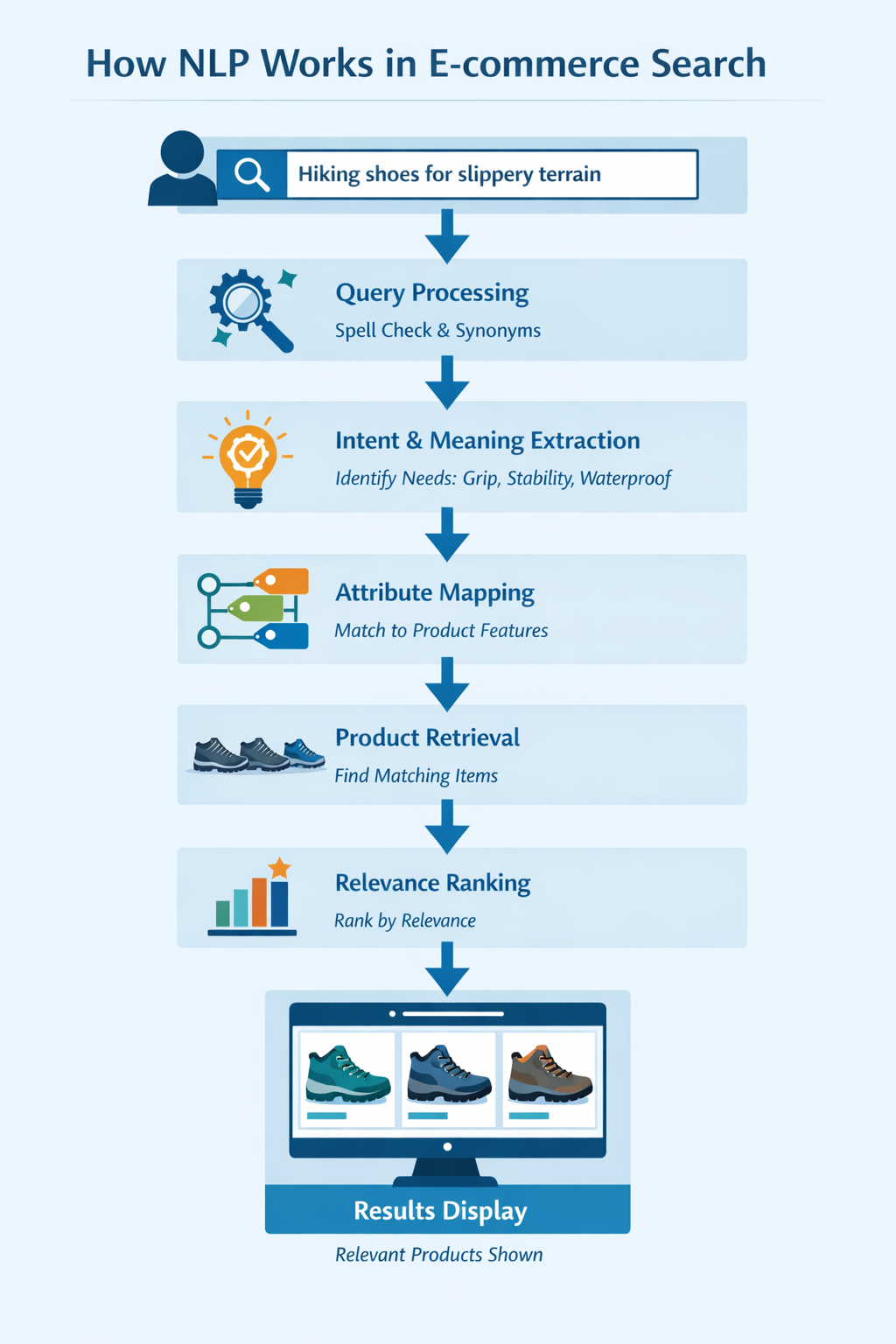
Here is an illustration of how an NLP would populate a search.
2. Learning-to-Rank (LTR) Models
LTR models help optimize the order in which products are displayed to users.
They analyze:
- User behavior: Clicks, dwell time, impressions, cart additions, and purchase history
- Product attributes: Price, category, brand, relevance scores, and seller reputation
These signals help personalize results for each shopper.
Unlike rule-based systems that need manual tuning, LTR automatically adapts as demand trends and inventory shift. This helps relevant products to display more consistently over time.
Here are the 3 learning-to-rank categories and what each ranks.
3: Hybrid Retrieval
Hybrid retrieval combines keyword-based retrieval with semantic matching to improve coverage and relevance. This literally means using two retrieval paths in parallel and merging the results.
Lexical (keyword) retrieval:
- Matches exact or near-exact terms in titles, tags, categories, and filters
- Ensures accuracy
- Prevents missing obvious matches
Semantic retrieval:
- Uses vector or embedding similarity to match meaning
- Links queries to attributes, descriptions, and inferred concepts
- Handles descriptive or non-precise language
For example, for a shopper searching for “hiking shoes for slippery terrain,”
- Keyword retrieval ensures products tagged with terms like hiking, trail, or outdoor are included.
- Semantic retrieval expands results to include products described as high-traction, water-resistant, or rubber outsole, even if the exact phrase “slippery terrain” does not appear.
4. Behavioral and Contextual Signals
AI search systems include behavioral and contextual signals to dynamically refine results.
Such signals include:
- Past searches
- Browsing pattern
- Location
- Device type
- Seasonality
These help customize results to the shopper's situation. The search results reflect context, improving relevance for different users and scenarios.
Benefits of Optimizing AI Search in Ecommerce Platforms
Optimizing for AI search transcends enabling AI features.
Here are the primary benefits:
1. Higher Conversion Rates from Search
Optimized AI search improves conversion by surfacing relevant products earlier and reducing friction at high-intent moments. This leads to:
- Higher add-to-cart rates from search sessions
- Fewer drop-offs caused by irrelevant results
- More revenue captured without increasing traffic
2. Faster Product Discovery
AI search allows customers to search naturally and still find relevant products. This shortens the discovery phase, leading to:
- Fewer failed or zero-result searches
- Reduced need for repeated query refinement
- Faster movement from search to product pages
3. Personalization That Drives Retention
Optimized AI search adapts results based on behavior and preferences, making repeat visits feel more relevant. As a result:
- Returning customers find products faster
- Search results improve over time per shopper
- Stronger brand familiarity across sessions
4. Scalable Search Performance as Catalogs Grow
As your assortments expand and inventory changes, optimized AI search automatically maintains relevance. This means:
- Consistent discovery across large catalogs
- Stable relevance during launches and seasonal changes
- Less degradation as SKUs and attributes increase
5. Actionable Search Insights for Better Decisions
AI search turns customer queries into insights that you can act on. This includes:
- Clear visibility into customer intent and demand
- Identification of content and catalog gaps
- Better input for product and merchandising decisions
You need to first know how your brand appears in AI search. This helps you identify gaps, missed opportunities, and intent mismatches before they cost your revenue.
A tool like WorkDuo helps you learn what AI is saying about your brand and competitors.
Sign up today and see how this works.
Key Considerations When Choosing an AI Search Tool for E-commerce
Choosing an AI search tool is about control, scalability, and whether the tool actually improves discovery and revenue without creating new operational complexity.
Here are the key elements you should consider:
1. Intent Interpretation Quality
The most important concern is whether the tool understands why a customer is searching, not just what they typed.
Strong AI search tools should interpret descriptive, use-case, and condition-based queries and precisely map them to your products.
Look for tools that:
- Handle natural language and long-tail queries well
- Match customer language to product attributes, not just titles
- Perform consistently across ambiguous or exploratory searches
2. Ranking Quality and Business Control
AI search should not be a black box. You need confidence that high-value, in-stock, and strategically important products surface appropriately.
Evaluate whether the tool:
- Allows visibility into ranking logic
- Supports business rules without overriding relevance
- Balances learning-based ranking with brand priorities
A tool like WorkDuo is ideal for improving ranking, optimizing your presence, and expanding visibility.
3. Scalability Across Catalog Growth and Change
As your catalog grows, relevance should not degrade.
An AI search tool must handle frequent changes in your inventory, pricing, and assortments without constant manual tuning.
Prioritize tools that:
- Maintain relevance as SKUs and attributes increase
- Adapt automatically to catalog and inventory updates
- Perform reliably during launches and seasonal peaks
4. Insight, Reporting, and Visibility
Search performance should be measurable and explainable. You need visibility into what customers search for, where discovery fails, and how AI interprets intent.
Strong AI for ecommerce tools should provide you with:
- Clear reporting on search behavior and outcomes
- Insight into failed or underperforming searches
- Actionable signals for merchandising and content decisions
A platform like WorkDuo helps you see exactly where and how your brand appears, what narratives AI is amplifying, and which sources are driving those answers.
Get started with WorkDuo today and gain the visibility you need to grow your presence.
5. Integration With Your Ecommerce Stack
AI search should seamlessly integrate with your existing systems, not require workarounds.
Poor integration increases operational overhead and limits impact.
Ensure the tool:
- Integrates cleanly with your ecommerce platform and CMS
- Connects to product data, analytics, and merchandising tools
- Does not require heavy engineering effort to maintain
6. Long-Term Ownership and Flexibility
Establish whether the tool gives you a long-term advantage or locks you into rigid workflows. AI search should grow with your brand and customer behavior.
Evaluate whether the platform:
- Supports ongoing optimization without vendor dependence
- Adapt as customer behavior and channels change
- Gives you ownership over the search strategy beyond outputs
Control Your Brand Presence in AI Search with WorkDuo
As AI search for ecommerce becomes a core way shoppers discover and evaluate products, many brands face a growing blind spot. They do not know how AI systems interpret, rank, or surface their products.
Lack of this visibility leads to:
- Missed discovery
- Inconsistent brand representation
- Lost revenue opportunities
WorkDuo solves this by giving you clear visibility into how AI search surfaces your products and where intent mismatches occur.
This helps you understand what is happening in AI-driven discovery and take informed action to improve how your brand appears.
Sign up with WorkDuo today to see how AI talks about your brand.
Fiona is the Co‑Founder of WorkDuo AI, where she helps brands optimize their AI search visibility. Previously, she co‑founded SHOPLINE, a smart commerce platform in Asia, and led its successful exit to a NASDAQ‑listed company in 2022. With deep expertise in scaling tech businesses and working with global investors, Fiona now advises startups on growth and data-driven decision-making, while leading WorkDuo’s mission to improve how brands are represented in AI-driven search.

Ready to try our product?
Sign up for a free consultation with our experts.


Follow Us on Social Media
Follow our profiles for daily updates, behind-the-scenes content, and more.




More articles