How to Rank in AI Overviews (Ultimate 2026 Guide)
.png)
- AI Overviews favor clarity and trust, not just rankings. Content is selected based on how easy it is to interpret, reuse, and attribute.
- Explicit answers and external validation increase inclusion. Clear structure, concrete data, and corroboration matter more than SEO tricks.
- Visibility requires a new measurement. Standard SEO tools do not show usage, citation, or brand framing in AI Overviews.
If you are searching for how to rank in AI Overviews, you have probably already felt the shift. Responses are being synthesized, brands are being summarized, and visibility no longer relies on blue links alone.
In 2024, Google confirmed that AI Overviews will reach over 1 billion global users per month. This means how your content is selected and cited influences how people understand your brand.
In this guide, we explain exactly how that selection works and how to rank in AI Overviews.
What Are AI Overviews?
AI Overviews (AIOs) are AI-generated summaries that surface at the top of Google search results for specific queries. They synthesize information from multiple web sources to directly respond to a user’s question rather than just listing blue links.
Here is an example of an AI overview for a specific question.
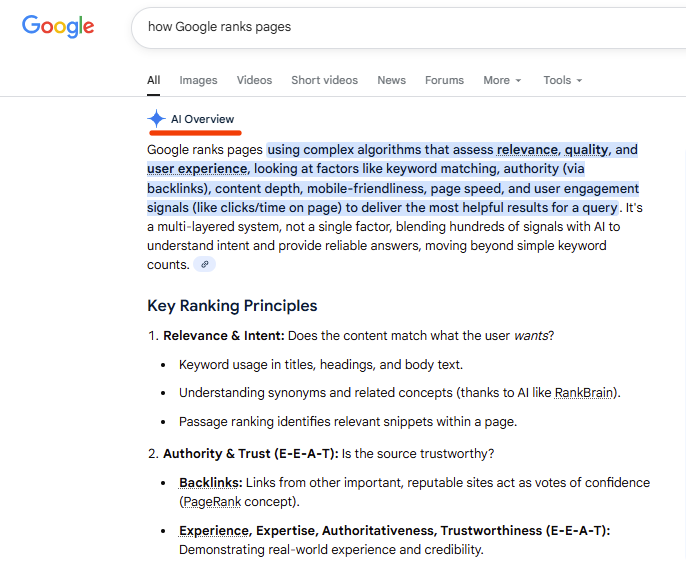
Unlike traditional results, AIOs:
- Extract content from multiple pages simultaneously
- Paraphrase and merge information
- Sometimes cite, but not always
This is not to discount traditional organic indexing and ranking. They still determine which pages are eligible for retrieval and use by the model.
How AI Overviews Differ from Traditional Search
Traditional search returns ranked web pages and leaves interpretation to the user.
Features like People Also Ask (PAA) and featured snippets still rely on individual sources. They do not combine information across pages.
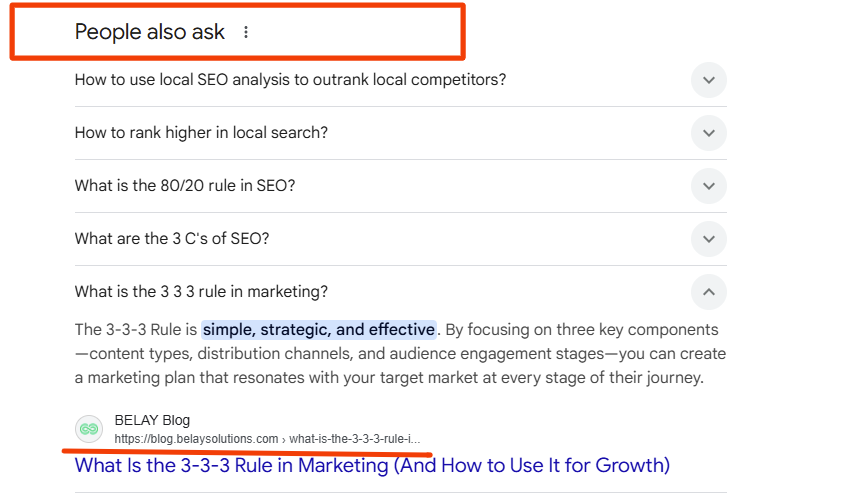
According to a 2025 BrightEdge report, People Also Ask is not a factor for AIO.
AIOs work differently. They combine information from various sources and synthesize it into a single explanatory response. This means users do not need to open several results to get the answer.
There is also a difference between your content being used and being cited in AI Overviews.
Your page can influence an AIO through retrieval and synthesis without the AI model explicitly referencing it. Basically, the model reads and understands your content, retrieves key facts or a direct answer, and uses this in the generated summary.
In citation, the AI model explicitly attributes the information to your page with a visible link. This means it trusts your content enough to recommend your page as a primary source.
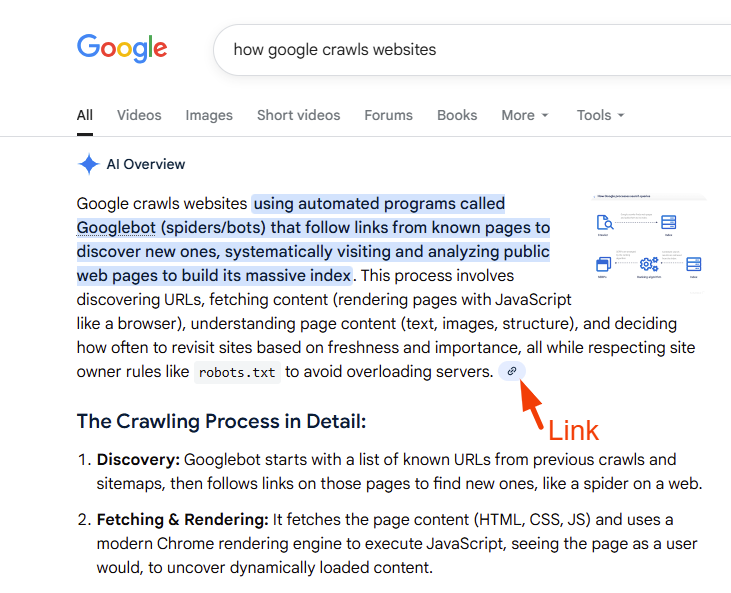
That is why optimizing for AI Overviews is not just about ranking higher. It’s about making your content clear, structured, and citation-worthy.
How Google Chooses Sources to Cite for AI Overviews
Google does not publish a fixed set of ranking factors for AI Overviews. Its documentation states that no additional or special optimization requirements are needed appear in the AI Overview. Instead, the best SEO practices remain relevant for featuring in AI Overviews.
Nevertheless, source selection reflects how easily your content can be retrieved, interpreted, and reused during AI synthesis.
Here are the macro-level signals that consistently influence citation and inclusion:
High-Quality, Structured Content
Content that is easy to parse and well-structured is more likely to be extracted and reused during AI synthesis. A logical structure helps models spot definitions, explanations, and conclusions without ambiguity.
In practice, this includes:
- Clear heading structure (H1, H2, H3) that logically categorizes topics
- Summaries, pros and cons lists, comparisons, and specific use cases
- Original insights that transcend generic explanations
- Visible updates indicators, such as the “last updated” date, to signal freshness
These minimize interpretation effort for AI systems, improving their suitability for synthesis and potential citation.
Schema Markup (Structured Data)
Schema helps Google understand your content faster and more precisely. Google highlights that structured data provides explicit clues about the contents of your page. This minimizes ambiguity during retrieval and synthesis.
Here’s what this entails:
- Clear entity definition, such as name, description, brand, and author
- Supported schema types such as product, article, review, or FAQ
- Metadata like publication date and main page entity
- Consistent, valid structured data across similar page types
Data Richness and Transparency
Data-rich content minimizes the need for inference. It clearly states facts, comparisons, and constraints that can be confidently reused during synthesis.
Transparent and rich data includes:
- Tables, charts, and structured comparisons that clearly distinguish options
- Clear details such as pricing ranges, feature lists, limits, or specifications
- Concrete statements about who a recommendation is for and who it is not for
- Explicit examples that support abstract concepts in a real-world context
Transparent data boosts trust and usability. This is because AI systems can retrieve discrete facts without generalization or guessing.
Credibility and Authority Signals
When generating AI overviews, Google’s systems tend to rely on sources that appear authoritative and trustworthy. This also aligns with Google’s E-E-A-T and quality rate guidelines.
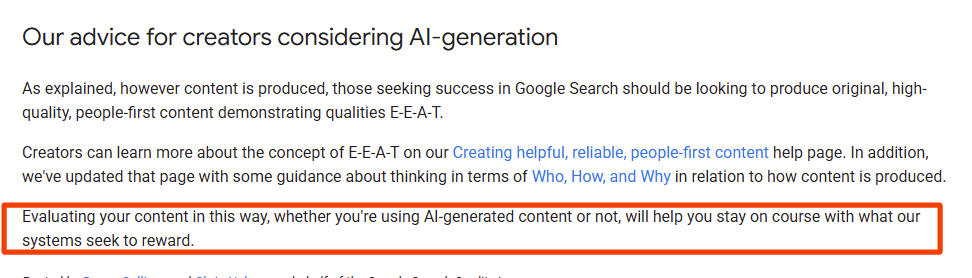
Clear signs of expertise and accountability minimize uncertainty about the precision of information being used.
These credibility signals include:
- Clearly identified authors
- Visible publication and update dates to signal accountability
- Neutral, informational tone with limited promotional language
These signals help LLMs evaluate whether information can be confidently summarized or cited, especially for explanatory or decision-focused queries.
External Validation and Real-World Consensus
When AI systems generate summaries, they tend to rely on information that can be validated across domains.
External references and visible consensus minimize the risk of bias and boost confidence in the synthesized information.
In practice, this includes:
- References to independent research, authoritative publications, and standards bodies
- Summaries of common viewpoints or consensus derived from user communities
- Balanced coverage that recognizes trade-offs or limitations
These help LLMs differentiate between isolated claims and broadly augmented information.
How to Optimize Content to Appear in AI Overviews
Optimizing for AI overviews is not about gaming prompts or manipulating rankings. You need to align with how Google’s AI systems retrieve, interpret, and reuse information.
Here are the steps you can apply across existing and new content.
Step #1: Structure Pages for AI Synthesis and Citation
Focus on making your content easy to retrieve, summarize, and attribute during AI overview generation. The goal is to ensure key page information can be confidently reused.
What to do:
- Place direct answers and definitions early in each section
- Use a clear H1, H2, and H3 hierarchy that reflects user intent
- Break complex explanations into separate, scannable sections
- End sessions with concise summaries or conclusions
A good example:
Opening a section with a direct definition, followed by an ordered explanation, and then ending with a brief takeaway.
Bad example:
Opening a section with background or storytelling before defining the topic. This buries the answer several paragraphs down.
Step #2: Use Schema to Clarify Entities and Context
Focus on helping Google AI systems understand what your content represents, not just the text on your page.
Schema provides clear signals about entities, relationships, and the purpose of your page. This improves inclusion and citation readiness.
What to do:
- Apply appropriate schema types based on page intent
- Define core entities such as product, author, organization, or topic
- Provide metadata that defines scope, context, and ownership
- Maintain consistency in structured data across similar pages
Good example:
Marking up a product comparison page with product and review schema, clearly defining brands, features, and review signals.
Bad example:
Having a comparison page with no structured data. Leaves AI systems to infer entities only from body context.
Step #3: Replace Vague Claims with Explicit Data
Focus on increasing data specificity, not just structure or layout. You want to remove ambiguity by clearly stating facts and criteria.
What to do:
- Replace qualitative claims with quantitative or factual details
- Define comparison criteria instead of subjective labels
- Use concrete examples to augment claims
Good example:
Plans start at $69/month and support up to 5 users
Bad example:
Affordable pricing for growing teams
Step #4: Strengthen Credibility and Attribution Signals
Clarify who is behind the content and why it can be trusted. AI overviews are more likely to cite sources that demonstrate expertise, transparency, and accountability.
This is not about promoting authority. It is centered on reducing uncertainty around authorship and reliability.
What to do:
- Clearly identify the author, publisher, or organization responsible for the content
- Augment key claims with references to trustworthy, independent sources
- Preserve a neutral, informational tone instead of a promotional one
Good example (clear attribution):
Using an article with a named author, a short bio, publication date, and cited external sources
Bad example (low trust):
Anonymous content with no sourcing, dates, or overly sales-driven language
Step #5: Reinforce Content with External Validation and Consensus
Demonstrate that your content is supported beyond your own site.
AI Overviews are more likely to summarize and cite information corroborated by independent authoritative sources or reflect a broadly accepted understanding.
The focus here is not on link building or promotion. It is showing that claims are not isolated.
What to do:
- Reference independent research, authoritative publications, and standard bodies where relevant
- Validate key ideas outside your own domain
- Reflect widely agreed-upon viewpoints or consensus when discussing topics
Good example
“Structured data helps search systems better understand your page content.”
This is a publicly verifiable claim documented in Google guidelines.
Bad example
“Structured data significantly boosts visibility in AI Overview SEO.”
This is not true. Structured data only improves the likelihood of AIO citation.
Off-Page Strategies for More Brand Visibility in AI Overviews
Off-page strategies focus on how your brand, concept, or product is represented, discussed, or corroborated across the web.
Rather, they help institute a broader context and validation that AI systems can exploit when synthesizing responses.
These off-page strategies include:
Strategy #1: Independent Mentions from Trusted Sources
The AI overview may display information that shows repeatedly across trusted third-party sources.
Therefore, mentions help establish that your brand or idea exists and is discussed outside your website.
Focus on:
- Being mentioned in editorial content on industry sites
- Appearing in curated guides, research pieces, or comparisons
Strategy #2: Strengthen Entity Consistency Across the Web
LLMs rely on consistent signals to understand entities.
Focus on:
- Using consistent product, brand, and category descriptions across platforms
- Ensuring third-party mentions mirror the same scope and positioning
- Minimizing ambiguity around what your brand or product represents
Strategy #3: Presence in Credible Community and Practitioner Discussions
LLMs may draw from widely discussed real-world perspectives when authoritative documentation is limited. These help surface how topics are experienced, debated, and understood in practice.
This is why platforms like Reddit and Quora matter. Google’s entering into a $60 million annual agreement to license Reddit’s data for AI use shows the value of UGC as a source for real-world insight.
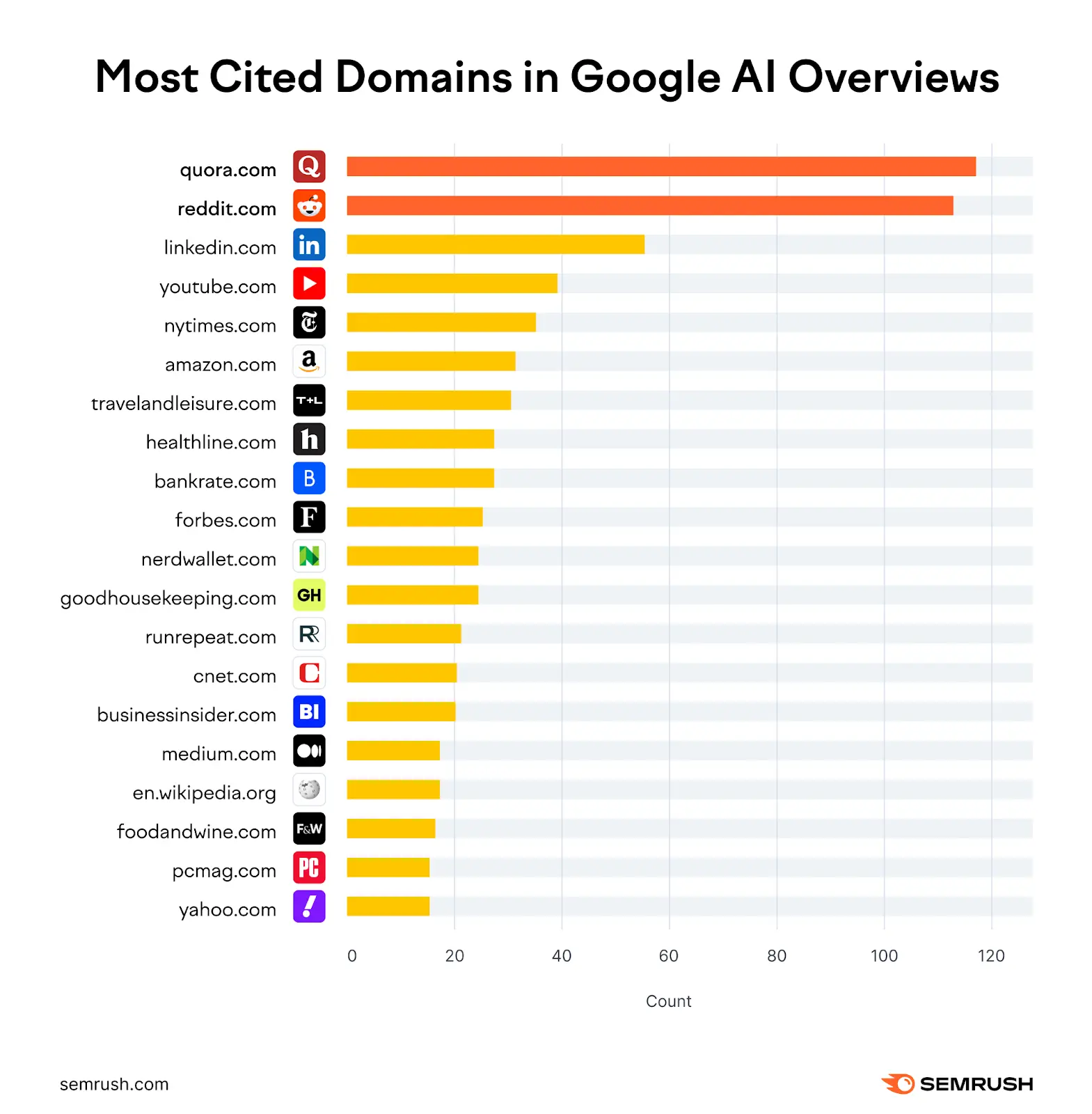
A Semrush AI search study also shows Quora as the most cited in Google AI overviews, followed by Reddit.
Here is what to focus on to capitalize on these platforms:
- Understand how key topics are discussed by practitioners and users
- Reflect recurrent concerns, questions, or trade-offs raised in these communities
- Avoid claims that contradict widely shared discussions without solid evidence
Strategy #5: Create Assets That Naturally Attract Mentions and References
Some content earns AI visibility because it is genuinely useful or unique. These assets become reference points across the web.
Focus on:
- Publishing data-rich guides, research summaries, or frameworks
- Prioritize usefulness and clarity over promotion
- Create content that others cite to augment their explanations
How to Track Your Visibility in AI Overviews
AI overviews introduce visibility gaps that traditional SEO metrics do not fully capture.
For example, Google Search Console excels in showing your site’s impressions and clicks. However, it does not show whether your content was used, summarized, or cited in AI-generated answers.
Therefore, you need a more deliberate, repeatable strategy to track visibility in AI overviews.
Here are the steps to help you understand where, how, and how frequently your content appears in AI Overviews.
For a broader look at the software landscape, you can also explore our breakdown of the best tools for monitoring AI overviews currently available to marketers.
Step #1: Define a Stable Set Relevant Queries
Start by identifying queries where AIOs consistently surface. These are typically explanatory, informational, or comparison-driven searches instead of navigational.
What to do:
- Choose high-value topics relevant to your product or brand
- Categorize queries by intent instead of individual keywords
- Lock a steady prompt set to avoid inconsistent inputs
Step #2: Monitor AI Responses Across Variants and Contexts
AI responses are not static. The same query can surface different outputs depending on context.
What to do:
- Observe answers across locations and languages
- Account for prompt phrasing and semantic variations
- Monitor changes introduced by model or system updates
- Compare output over time instead of relying on single observations
Step #3: Distinguish Between Usage, Paraphrasing, and Citation
AIOs may use content in different ways.
What to do:
- Establish whether your content is directly cited or indirectly paraphrased
- Distinguish brand mention from unattributed content influence
Step #4: Track Brand Framing and Context, Not Just Presence
Visibility alone does not translate to impact. How your brand is described influences perception.
What to do:
- Track how your brand is positioned within the AI answers
- Highlight recurring descriptors, qualifiers, or comparisons
- Spot changes in framing over time
- Compare your brand treatment against alternative or competitors
This helps you understand narrative impact, not just exposure.
Step #5: Use Systematic Tooling to Scale Observation and Benchmarking
Manual monitoring cannot keep pace with the variability of AI-generated answers.
You need to:
- Automate prompt execution and response capture
- Create consistent benchmarks across queries and time periods
- Spot patterns instead of isolated inputs
- Scale observations without treating visibility as a ranking shortcut
A dedicated tool like WorkDuo supports these strategies and promotes repeatable measurements.
Get started with WorkDuo today, and get insights on how to rank in AI overviews.
Common Mistakes That Prevent AI Overview Visibility
AIO visibility is often limited by misalignment with how AI systems extract, synthesize, and present information.
Here are some of the common reasons why your content may fail to appear or be cited:
- Burying answers behind long introductions: This makes AI engines struggle to identify the primary answer. It reduces extractability during synthesis.
- Lack of clear definitions or conclusions: If your content does not explicitly state what something is, does, or applies to, it becomes harder to summarize into a concise AI answer.
- Thin or generic content with no information gain: Do your pages restate widely available explanations without adding clarity, original perspective, or specificity? Then they offer little value for synthesis.
- Vague claims without explicit facts: Using statements like “powerful,” “best,” or “scales well” without adding concrete details compounds ambiguity and lowers reuse.
- Overly promotional or biased framing: If your content reads as marketing copy rather than a neutral explanation, it is less ideal for summarization.
Monitor Your Brand Visibility and Optimize for AI Overviews with WorkDuo
Mastering how to rank in AI overviews begins with visibility. If you do not understand how your content is used, cited, or framed in AI results, optimization becomes guesswork.
WorkDuo provided insights into these visibility gaps. It helps you systematically track how your brand appears across AI Overviews over time.
Book a demo today and see how WorkDuo supports scalable AI Overview visibility monitoring.
Fiona is the Co‑Founder of WorkDuo AI, where she helps brands optimize their AI search visibility. Previously, she co‑founded SHOPLINE, a smart commerce platform in Asia, and led its successful exit to a NASDAQ‑listed company in 2022. With deep expertise in scaling tech businesses and working with global investors, Fiona now advises startups on growth and data-driven decision-making, while leading WorkDuo’s mission to improve how brands are represented in AI-driven search.

Ready to try our product?
Sign up for a free consultation with our experts.


Follow Us on Social Media
Follow our profiles for daily updates, behind-the-scenes content, and more.




More articles